
The UK Market’s Deceptive ‘Gaming PC’ Phenomenon: Repackaged Older Hardware at Inflated Prices
The UK market for ‘gaming PCs’ is currently facing a pervasive and concerning issue: the widespread sale of systems containing significantly outdated or second-hand internal components, deceptively repackaged into modern, aesthetically appealing cases with flashy LED lighting and cooling fans. These machines are then marketed at exorbitant prices, often comparable to or exceeding the cost of genuinely new systems with contemporary, high-performance hardware. This practice exploits a significant knowledge gap among consumers, particularly those less familiar with PC specifications, generations, and true market values, leading to widespread financial detriment and a sub-optimal user experience.
The core of the problem lies in the strategic re-use of computer internals, predominantly Intel CPUs from the 2nd to 7th generations (dating from 2011 to 2017) and graphics processing units (GPUs) from the 2011-2014 era. These components, despite their age, are integrated into new chassis, coupled with RGB fans and transparent side panels, to create an illusion of a high-performance gaming machine. The misleading advertisement often highlights generic specifications such as “Core i7” or “16GB RAM,” deliberately omitting crucial details like the component’s generation or specific model number. Consequently, buyers are paying a substantial premium – often 3 to 5 times the true second-hand value of the internal components – for aesthetics that do not translate into actual gaming prowess or future-proofing.
Key Takeaways
- Many ‘new’ UK gaming PCs contain 6-12 year old CPUs (2nd to 7th Gen Intel) and GPUs (2011-2014 era) in modern, RGB-laden cases.
- Consumers frequently pay a 3-5x markup, with systems worth £200-£300 being sold for £600-£1200 or more.
- Online marketplaces like eBay UK are flooded with over 40,000 such listings, preying on less tech-savvy buyers.
- Performance is severely impacted; these PCs struggle with modern games and often lack Windows 11 compatibility.
- The ‘RGB tax’ means buyers pay a premium for aesthetics rather than actual computing power.
- These systems often feature cheap components (e.g., PSUs) and offer virtually no upgrade path, leading to hidden long-term costs.
- Deceptive marketing hides critical details, focusing on generic specs while omitting component generation.
1. Executive Summary
The UK market for “gaming PCs” is experiencing a pervasive and concerning issue: the widespread sale of systems containing significantly outdated or second-hand internal components, deceptively repackaged into modern, aesthetically appealing cases with flashy LED lighting and cooling fans. These machines are then marketed at exorbitant prices, often comparable to or exceeding the cost of genuinely new systems with contemporary, high-performance hardware. This practice exploits a significant knowledge gap among consumers, particularly those less familiar with PC specifications, generations, and true market values, leading to widespread financial detriment and a sub-optimal user experience.
The core of the problem lies in the strategic re-use of computer internals, predominantly Intel CPUs from the 2nd to 7th generations (dating from 2011 to 2017) and graphics processing units (GPUs) from the 2011-2014 era. These components, despite being 6 to 12 years old, are integrated into new chassis, coupled with RGB fans and transparent side panels, to create an illusion of a high-performance gaming machine. The misleading advertisement often highlights generic specifications such as “Core i7” or “16GB RAM,” deliberately omitting crucial details like the component’s generation or specific model number, which would immediately reveal its age and performance limitations. Consequently, buyers are paying a substantial premium – often 3 to 5 times the true second-hand value of the internal components – for aesthetics that do not translate into actual gaming prowess or future-proofing.
The scale of this issue is considerable within the UK. Online marketplaces, notably eBay UK, host over 40,000 listings for “gaming PCs” at any given time, many of which are suspected to fall into this category of repackaged older hardware[7]. The financial implications for consumers are severe. A notable example involved a Spanish buyer who paid €1,200 for a “new” gaming PC in 2025 that was later found to contain an Intel Core i5-2500 (from 2011) and a GTX 1660 Ti (from 2019), components whose combined second-hand market value was less than €300[1]. This represents a markup of approximately 300% on the intrinsic value of the core hardware. Such practices are not isolated incidents but rather a systemic problem driven by readily available cheap older components and significant profit margins for sellers.
This executive summary outlines the key facets of this issue, providing an overview of its causes, prevalence, financial impact on consumers, the deceptive marketing tactics employed, and the significant negative consequences for performance and system longevity. It also highlights the critical need for increased consumer awareness and stringent platform regulation to safeguard UK buyers from these exploitative practices.
1.1. The Pervasive Nature of Deceptive ‘Gaming PC’ Sales in the UK
The landscape of budget gaming PC sales in the UK market is significantly marred by a prevalent issue where older computer internals are repackaged into modern-looking cases and marketed as new or high-performance gaming systems at inflated prices. This phenomenon is not merely anecdotal but is supported by extensive evidence from various online marketplaces and tech community discussions.
Research indicates that it is “surprisingly common” for many budget gaming desktops sold online to feature hardware that is significantly aged, sometimes 6 to 12 years old, despite being presented in contemporary, often RGB-illuminated chassis[1][2]. These systems typically utilise Intel CPUs ranging from the 2nd to 7th generations (e.g., Core i5-2500 from 2011, Core i7-3770 from 2012, or even i7-7700 from 2017), alongside GPUs from the 2011-2014 period (such as the Nvidia GTX 650 or GTX 750)[2][3]. The disparity in age between repackaged CPUs, which can be up to 14 years old (e.g., Core i5-2400 launched in January 2011), and the newer cases they inhabit, highlights the extent of this practice[13].
A significant indicator of the scale of this issue in the UK is the sheer volume of relevant listings on prominent online marketplaces. As of late 2024, eBay UK alone presented approximately 41,979 results for “Gaming Computer” desktops[9]. A substantial number of these listings likely include refurbished corporate PCs or self-assembled units with older internals, blurring the lines between truly new, high-performance systems and cleverly disguised outdated ones. For instance, one UK listing advertised an “Ultra Fast” Core i5 2nd Gen + GTX 1660 system for £714.99, a price point that significantly overstates the modern-day value and performance capabilities of its core components[5].
This issue is not confined to obscure sellers; even seemingly reputable brands have engaged in similar practices. For example, the U.S.-based company Alarco, whose business model involves selling pre-built “gaming” PCs at price points around $450-$500, uniformly uses 2011-era Intel CPUs and 2012-2014 GPUs across all seven of its models[2]. Despite these clearly outdated specifications, Alarco’s products have amassed over 4,500 reviews on Amazon with an average rating of 3.8 stars, indicating that thousands of consumers have purchased these outdated machines, often mistakenly believing them to be contemporary gaming rigs[2]. This suggests a significant segment of the market, particularly those seeking entry-level systems or parents purchasing for children, lacks the technical knowledge to discern the true value and performance of the components.
The underlying motivation for sellers is clear: high profit margins derived from the low cost of acquiring and repurposing older hardware. There is an “abundant supply of last-decade hardware” available at minimal cost, stemming from businesses upgrading their office PCs or gamers selling older parts after upgrading. A 2011 Intel i5-2400 or i7-2600, salvaged from an old workstation, can be purchased for a mere few dozen pounds. By combining such a cheap CPU with other legacy components and an inexpensive modern case, sellers can achieve significant markups, sometimes turning a £200 build cost into a £600–£800 selling price, representing a 200-300% profit margin[16]. This lucrative business model is further fueled by the “RGB tax,” where consumers are willing to pay a premium for superficial aesthetics like LED fans, mistakenly equating flashy looks with high performance[7].
1.2. Financial Discrepancies and Consumer Risks
The immediate and most significant consequence of these deceptive practices is the substantial financial loss incurred by unsuspecting consumers. Buyers are frequently led to believe they are purchasing a modern, capable gaming PC, only to discover that the internal components are severely outdated and worth a fraction of the price paid.
1.2.1. Exorbitant Markups on Obsolete Hardware
One of the most striking illustrations of financial discrepancy comes from a case in Spain, where a father purchased a “new” gaming PC for €1,200, expecting a high-performance machine for his son[1]. However, the system contained an Intel Core i5-2500 CPU, released in 2011, and a GTX 1660 Ti GPU, released in 2019. The combined second-hand market value for these components was estimated at under €300 at the time of purchase in 2025, meaning the buyer paid approximately four times the true worth of the internal hardware[1]. This represents a significant markup, demonstrating how easily purchasers can be overcharged for obsolete or semi-obsolete technology.
Similarly, a system featuring a 12-year-old Core i7-3770 was listed for $550, even though comparable used PCs with better GPUs could be acquired for around $200[4]. This implies a markup of approximately 175% for what was essentially a basic older system with a “flashy case and RGB lights.” This “RGB tax” phenomenon, where aesthetics rather than performance drive up prices, is a consistent theme identified in these practices[7]. Many sellers strategically invest a small amount (e.g., £20) in LED lights and modern-looking cases to justify charging hundreds of pounds more for an old system[16].
1.2.2. Performance Deficiencies and Compatibility Issues
Beyond the financial overpayment, consumers face severe performance limitations and compatibility challenges. The older CPUs and GPUs often struggle significantly with modern software and games. For instance, a GTX 750 or similar GPU (frequently found in these budget-oriented machines) “cannot run recent AAA titles smoothly”[3]. Even entry-level modern GPUs outperform these older components dramatically. A 2011 Core i5 CPU combined with a GTX 750, for example, can only deliver acceptable frame rates (around 60 FPS) in very light or older games like Rocket League at 1080p. In contrast, a genuinely new $500 gaming PC could achieve 60+ FPS in popular titles at high settings using a mid-range modern GPU[10]. This significant performance gap means buyers are receiving a fraction of the expected gaming experience for their investment.
Furthermore, these systems often come with critical compatibility issues that create hidden costs. Perhaps most notably, Intel CPUs from the 2nd to 7th generations (the mainstay of these repackaged PCs) do not meet the hardware requirements for Windows 11[4]. This means such systems are effectively “stuck on Windows 10,” an operating system whose extended support is scheduled to end in October 2025. This poses a significant security and functional risk for users, who will face the choice of operating an unsupported OS or incurring the substantial cost of a full platform upgrade (CPU, motherboard, and RAM) much sooner than anticipated. This effectively transforms any perceived initial “savings” into a significant long-term expense.
1.2.3. Limited Upgrade Paths and Increased Failure Risk
The internal architecture of these older systems (e.g., DDR3 RAM, outdated CPU sockets) presents a “dead-end” for upgrades. Components are typically so old that any meaningful upgrade often necessitates “replacing every single part” of the system, including the motherboard, CPU, and RAM (e.g., moving from DDR3 to DDR5)[3]. The power supplies (PSUs) in these builds are also frequently cheap, unbranded units lacking essential protections, making them unreliable and unsuitable for powering newer, more demanding components. This means that instead of merely upgrading a GPU or CPU, consumers are forced into rebuilding the entire system, rendering their initial “gaming PC” purchase a poor foundation for future expansion. The Spanish case involving the i5-2500 and GTX 1660 Ti exemplified this, as the decade-old CPU severely bottlenecked the newer GPU by approximately 35% in games, making the combination inefficient and frustrating[8].
Finally, the use of predominantly second-hand and aging components increases the risk of premature hardware failure. Capacitors on 10-year-old motherboards may be nearing the end of their operational life, and used mechanical hard drives can have significant wear. The generic, low-quality PSUs often included are more prone to failure and can even damage other components if they malfunction. This introduces an element of uncertainty and potential additional costs for repairs or replacements that would not typically be expected in a genuinely new system with a full warranty.
1.3. Deceptive Marketing Tactics and Consumer Vulnerability
The persistent success of these exploitative sales is largely attributed to sophisticated, albeit deceptive, marketing tactics that prey on consumer vulnerability and a widespread lack of in-depth technical knowledge. Sellers leverage visual appeal and ambiguous language to mask the true nature of their products.
1.3.1. The ‘RGB Effect’ and Aesthetic Deception
A primary tactic employed by these sellers is the heavy emphasis on external aesthetics. “Bright LED fans, transparent cases, and aggressive product names” such as “Ultra Fast” or “Gaming Pro” are crucial elements in creating a powerful, premium perception for systems housing very low-end components[7]. This strategy exploits the common consumer belief that a visually impressive and “gamer-styled” machine equates to high performance. Tom’s Guide aptly termed this the “RGB tax,” observing that consumers can pay “hundreds more” for a flashy design that offers no performance benefit[7]. In the context of repackaged older hardware, this tax is even more egregious, as the budget is almost entirely allocated to superficial elements rather than functional power.
1.3.2. Ambiguous and Misleading Specifications
Sellers commonly employ generic or incomplete specifications to obscure the age and performance of internal components. They frequently highlight large, impressive-sounding numbers without providing critical context. Examples include advertising “32GB RAM” without specifying if it’s slow DDR3, or “4GB graphics” without mentioning the GPU model or generation (e.g., a GeForce GT 730, an entry-level card from 2014, often had 4GB of VRAM but almost no gaming power)[11]. The core processors are often listed vaguely as “Intel Core i7” or “Intel 4th Gen,” deliberately omitting the specific model number that would instantly reveal its age (e.g., an i7-2600 from 2011 versus a modern i7-14700K). This leverages the average consumer’s understanding that an “i7” is generally powerful but conceals the vast performance difference between generations. A 2012 Core i7-3770, for instance, is vastly inferior to even a modern Core i3, yet it might be presented as a high-tier gaming CPU to an uninformed buyer[4].
Furthermore, advertisements often resort to using “semi-true buzzwords” or listing expected features as selling points. Phrases like “VR Ready” may be used even when the GPU can barely render basic desktop environments, let alone VR. Listing “WiFi Ready” or “Windows 10 Pro installed” are examples of common features presented as unique selling points, distracting from the genuine performance metrics. This strategic omission of crucial details forces consumers to make purchase decisions based on incomplete and potentially misleading information.
1.3.3. Erosion of Trust Through Fake Reviews and Social Proof
The issue is exacerbated by the use of artificial social proof, including “bought followers and fake positive comments” on social media or generic 5-star reviews on e-commerce platforms[12]. These fabricated testimonials create an illusion of product quality and seller trustworthiness, convincing potential buyers that they are making a safe and satisfactory purchase. Alarco’s success on Amazon, despite its outdated hardware, is a testament to the power of accumulated reviews, regardless of their intrinsic value or the underlying product quality[2]. This tactic further insulates such sellers from scrutiny and helps to perpetuate the cycle of overpricing outdated hardware.
1.4. Recommendations for Consumer Protection and Market Integrity
To mitigate the adverse effects of these deceptive practices on UK consumers and uphold market integrity, several measures are imperative.
1.4.1. Empowering Consumers Through Education
The primary defense against these scams is an informed consumer base. It is critical to:
- Emphasise Component Generation: Buyers must be educated to look beyond generic labels like “Core i7” and inquire about the precise generation and specific model number of CPUs and GPUs. Familiarity with component release dates is crucial.
- Promote Critical Ad Scrutiny: Teach consumers to be wary of advertisements that heavily feature aesthetics (RGB lighting, case design) while being vague about core hardware specifications. Any deliberately omitted detail should be a red flag.
- Advise Against “Too Good To Be True” Offers: Educate consumers that genuine, modern gaming PCs typically have a floor price. If an offer appears to provide high-end performance for an implausibly low cost (e.g., a “Core i7 Gaming PC” for £300), it almost certainly contains significantly outdated components.
- Encourage Independent Research and Expert Consultation: Encourage buyers to consult reputable tech forums, review sites, or knowledgeable individuals before making a significant purchase. As highlighted by the Spanish case, a quick check with an expert could have prevented a €1,200 loss[1].
1.4.2. Strengthening Platform Accountability and Regulation
Online marketplaces and e-commerce platforms have a significant role to play in curbing these deceptive sales:
- Mandate Comprehensive Spec Listings: Platforms should enforce stricter rules requiring sellers to provide full, unambiguous specifications, including exact CPU model and generation, GPU model, RAM type and speed, and PSU brand/wattage. This transparency would immediately expose outdated components.
- Combat Fake Reviews: Develop and implement more robust systems to detect and remove fake reviews and ratings, thereby restoring trust in user-generated content.
- Improve Categorization and Filtering: Implement clearer categorization that distinguishes between genuinely new, professionally refurbished (with transparent component lists), and second-hand/repackaged systems. Consumers should be able to filter listings based on CPU/GPU generation.
- Enforce Misrepresentation Policies: Actively monitor and sanction sellers who misrepresent the age, condition, or performance of their products. Stiffer penalties for deceptive advertising are needed.
1.4.3. Alternative Purchasing Strategies
For consumers on a budget, safer alternatives exist:
- Reputable Retailers: Advise purchasing from established PC system integrators or well-known electronics retailers that offer warranties and detailed, accurate specifications for new-generation components.
- Official Refurbished Channels: If a refurbished PC is desired, direct consumers towards officially certified refurbished machines from manufacturers or their authorized resellers. These often come with clear disclosures and warranties that mitigate risk.
- DIY Building: For those with a modicum of technical confidence, building a PC from scratch offers the best value and full control over component choice, ensuring no outdated parts are included unnecessarily.
Table 1.1 illustrates the typical age and performance benchmarks of components found in these “gaming PCs” versus what would be expected from a genuinely modern, budget-friendly gaming machine.
| Component Type | Repackaged “Gaming PC” (Typical) | Modern Budget Gaming PC (Reference) | Performance Impact |
|---|---|---|---|
| CPU (Generation/Year) | Intel Core i5-2500 (2nd Gen, 2011) to i7-7700 (7th Gen, 2017)[13] | Intel Core i3-12100F (12th Gen, 2022) or AMD Ryzen 5 5500 (2022) | Significantly lower single-core and multi-core performance; lack of modern instruction sets and Windows 11 compatibility. Potentially 35% bottleneck to newer GPUs[8]. |
| GPU (Model/Year) | Nvidia GTX 650 (2012), GTX 750 (2014) or sometimes GTX 1660 Ti (2019)[2] | Nvidia RTX 3050 (2022) or AMD RX 6600 (2021) | Unable to play recent AAA titles smoothly; limited to low settings or older/lighter games. GTX 750 struggles to maintain 60 FPS in many modern titles[3]. |
| RAM (Type/Speed) | DDR3 (typically 1333MHz or 1600MHz) | DDR4 (3200MHz) or DDR5 (4800MHz+) | Significantly slower memory bandwidth, impacting overall system responsiveness and game performance. |
| Motherboard/Socket | LGA1155 (for 2nd/3rd Gen) or LGA1151 (for 6th/7th Gen) – outdated sockets. | Modern sockets (e.g., LGA1700, AM4/AM5) with current features and upgrade paths. | Zero upgrade potential for CPU; limited support for modern storage (NVMe) and connectivity. |
| Operating System Support | Windows 10 (End of Life Oct 2025); incompatible with Windows 11[4]. | Windows 11 compatible and fully supported. | Hidden cost of forced OS upgrade or security risks if using an unsupported OS. |
| Typical Selling Price (UK) | £600 – £1200+ | £700 – £1200+ | Massive overcharge for significantly inferior performance. |
In conclusion, the market for “gaming PCs” constructed from outdated components and sold at inflated prices is a significant fraud impacting UK consumers. The deceptive practices, leveraging cosmetic appeal and ambiguous specifications, create considerable financial and performance risks. By enhancing consumer education, strengthening regulatory oversight on marketplaces, and promoting transparent sales practices, the industry can protect consumers and foster a more honest and reliable market for computer hardware.
This executive summary provides a high-level overview of the issue. The subsequent sections of this report will delve into each of these areas with greater granularity, providing deeper analysis, specific case studies from the UK market where possible, detailed technical explanations of component performance, and a comprehensive review of consumer protection mechanisms.
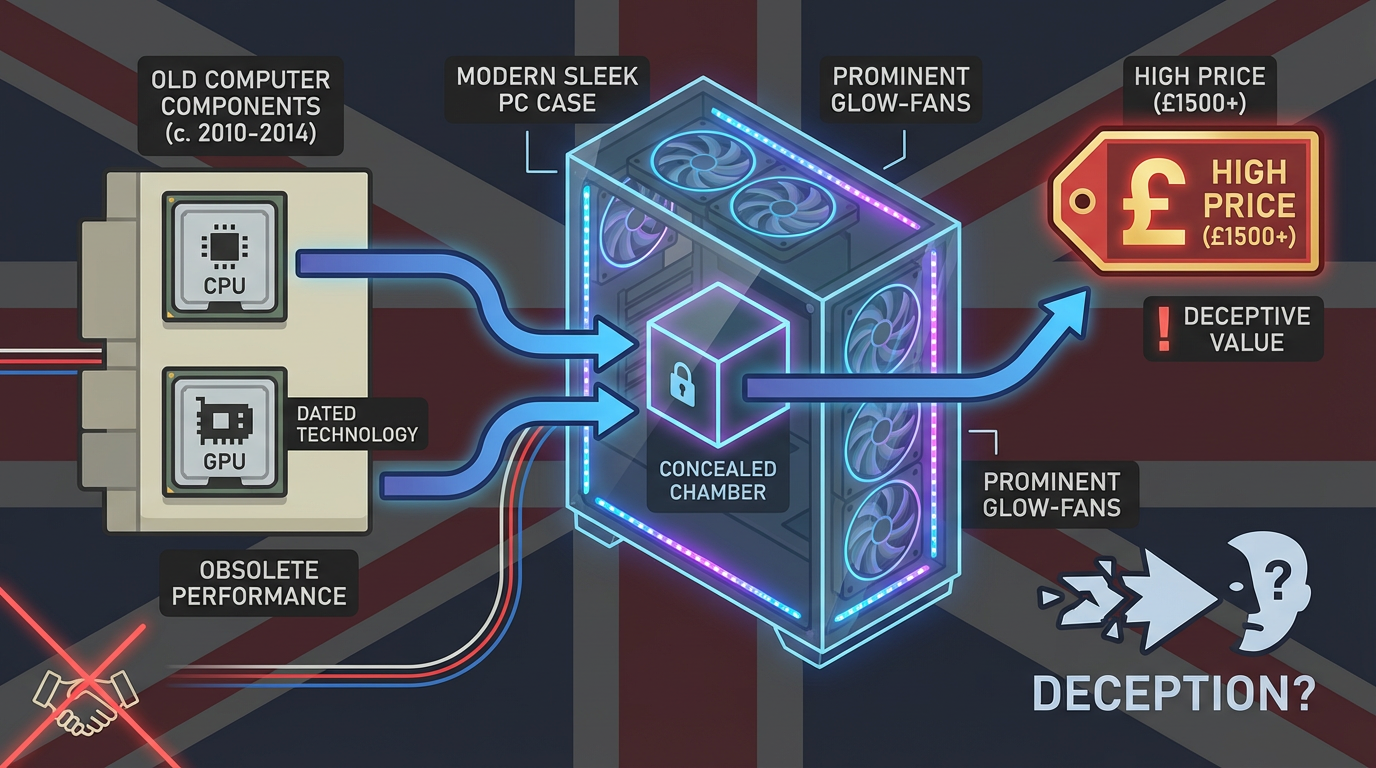
2. The Deceptive Practice of Repackaging Old Hardware
The burgeoning market for “gaming PCs” in the UK and beyond, particularly those advertised at ostensibly attractive price points, often conceals a pervasive and deeply problematic trend: the systematic repackaging of decade-old computer internals into flashy new cases adorned with LED lights and elaborate cooling systems. This deceptive practice exploits a significant knowledge gap among consumers, leveraging aesthetic appeal and misleading terminology to sell severely outdated hardware at grossly inflated prices. Far from being “new” or “high-end deals,” these machines frequently house CPUs and GPUs dating back to 2011-2014, components that offer a fraction of the performance of modern equivalents and come with inherent compatibility and upgrade limitations. This section will delve into the mechanisms of this deception, exploring the types of hardware used, the marketing strategies employed, the motives behind such practices, and the profound negative consequences for unsuspecting buyers.
2.1 The Illusion of Modern Gaming: Repackaging and Misdirection
At the core of this deceptive practice is the art of illusion. Vendors take computer internals that are 6-12 years old, originating from generations of Intel Core processors (2nd to 7th gen) and graphics cards (often from 2011-2014), and house them within brand new, aesthetically pleasing cases. These cases are typically equipped with RGB lighting, tempered glass panels, and an array of fans, creating a visual spectacle that implies high performance and contemporary design. However, this external flair serves primarily to mask the obsolete technology within. Sellers often advertise these systems with vague, yet seemingly impressive, specifications, such as “Core i7” or “16GB RAM,” without specifying the generation or speed of these components. This strategic omission allows them to capitalise on brand recognition while delivering subpar performance [13], [20].
A stark illustration of this misdirection comes from a case in Europe in 2025 where a father paid €1,200 for a “new” gaming PC for his son. Upon closer inspection by tech experts, it was revealed that the machine contained an Intel Core i5-2500 CPU, a processor launched in 2011, paired with an Nvidia GTX 1660 Ti GPU, which, while newer (2019), was severely bottlenecked by the ancient CPU [3], [13]. The combined second-hand market value of these components was estimated to be under €300, rendering the PC roughly four times overpriced [3]. This €900 discrepancy exemplifies the exorbitant markups applied to these systems. Another example highlights a PC listed for $550 containing a 12-year-old Core i7-3770, while comparable used systems with superior GPUs were available for approximately $200, representing a 175% markup purely for a flashy case and RGB lights [4], [7].
The scale of this issue is significant. On eBay UK alone, there are over 40,000 “gaming PC” listings at any given time [6], many of which are refurbished office PCs simply fitted with RGB fans. This vast quantity of listings creates a fertile ground for these deceptive practices to flourish, making it challenging for an average consumer to distinguish genuine value from overvalued, antiquated hardware.
Table 2.1: Key Characteristics of Repackaged Gaming PCs vs. Modern Equivalents
| Feature | Repackaged “Gaming PC” | Modern Entry-Level Gaming PC (New, approx. £600-£700) |
|---|---|---|
| CPU Generation | Intel 2nd-7th Gen (2011-2017)[1], [10] | Intel 12th-14th Gen or AMD Ryzen 5000/7000 series |
| GPU Generation | Nvidia GTX 650/750 (2012-2014)[2] or GTX 1660 Ti (2019) | Nvidia RTX 3050/4060 or AMD RX 6600/7600 |
| RAM Standard | DDR3 (often 1333MHz or 1600MHz) | DDR4 (3200MHz+) or DDR5 (4800MHz+) |
| OS Support | Windows 10 (End of Life Oct 2025)[8] | Windows 11 (fully supported) |
| Performance (AAA games 1080p) | Often struggles to maintain 30-60 FPS even on low settings[11] | Comfortably 60+ FPS on medium-high settings |
| Upgrade Path | Severely limited; often requires replacing every core component[12] | Generally supports CPU/GPU upgrades within the same platform |
| Market Price vs. True Value | 3-5x overpriced relative to second-hand component value[7] | Generally fair market value for new components |
| Aesthetics | Flashy RGB, transparent panels, aggressive “gamer” designs | Varies; performance often prioritised over aesthetics at base level |
2.2 The Appeal of Obsolete Hardware: Low Costs, High Margins, and Pandemic Influence
The prevalence of this practice is driven by a straightforward economic model: high profit margins enabled by a cheap supply of components and low consumer awareness. The market is awash with what can be considered a “glut of last-decade hardware” [3]. As businesses upgrade their office infrastructure and gamers replace older GPUs, a steady stream of decommissioned PCs and individual components becomes available at extremely low prices. An Intel i5-2400 or i7-2600, for instance, can be sourced for merely a few tens of pounds from the second-hand market or e-waste recyclers. By combining such a CPU with other legacy parts and an inexpensive modern chassis (which might cost around £40-£50), vendors can construct a system with minimal capital outlay.
Consider the example of a UK listing spotted on OnBuy.com, where an “Ultra Fast Gaming PC” was offered for £714.99. This system bundled a refurbished Intel i5 2nd Gen processor, 16GB of older DDR3 RAM, and an Nvidia GTX 1660 GPU [5]. Including a used 19-inch monitor, gaming peripherals, and an RGB-lit case (like the CiT Seven), the total hardware cost to the seller was likely well under £200. This represents a potential profit margin of 200-300%, a highly attractive proposition for sellers aiming to maximise returns on minimal investment [17].
The COVID-19 pandemic and the ensuing global GPU shortage between 2020 and 2022 inadvertently provided a catalyst for this market segment. With new graphics cards becoming prohibitively expensive or entirely unavailable, some companies, such as the US-based Alarco (founded around 2019), identified an opportunity. They began repackaging older, readily available GPUs, which had previously been undesirable, into “budget gaming PCs” [16]. As new GPU prices soared, consumers, desperate for any gaming solution, became more amenable to systems featuring older GTX 700-series cards. This period legitimised the model for some vendors, and even after component prices stabilised, the established demand and profitable framework ensured the continuation of this practice. Alarco’s success is a testament to this, with their two longest-standing Amazon listings garnering over 4,500 reviews with an average rating of 3.8 stars, implying thousands of consumers have purchased these outdated rigs [2], [10].
Furthermore, this practice ties into the broader issue of e-waste management. Large IT liquidators and recyclers frequently auction off pallets of outdated corporate desktops at extremely low prices. Refurbishment outfits acquire these job lots, strip them for functional parts, and then repurpose them. While the re-use of components can be framed as an environmentally positive action, in this context, it’s primarily a profit-driven enterprise. Yesterday’s discarded office machinery, with a lick of paint and some flashing lights, is transformed into a “gaming PC” fetching several multiples of its true worth. The ease with which unsuspecting buyers can be attracted, particularly during sales events or holidays, means that a significant portion of consumers are unknowingly contributing to this market. They are enticed by the offer of affordability, blinded by the aesthetics, and lacking the technical knowledge to scrutinise the underlying components.
2.3 The “RGB Tax” and “Core i7” Effect: Marketing Over Substance
The marketing strategies employed by vendors of these repackaged gaming PCs are heavily reliant on superficial appeal and misleading terminology, often at the expense of substantive information. This phenomenon has been aptly termed the “RGB tax” by industry experts, highlighting that buyers are often paying a premium for aesthetics rather than performance [9], [19].
The focus is squarely on external presentation. Bright LED fans, transparent side panels, and aggressive, “gamer”-centric case designs are used to cultivate an image of a powerful, modern rig. This visual spectacle draws the eye and creates an immediate impression of value, even when the internal components are profoundly outdated. Tom’s Guide, for instance, noted that a flashy gaming system like an Alienware Aurora could cost “hundreds of pounds more” than a functionally equivalent, albeit “boring,” Dell desktop, with the premium largely attributable to aesthetics and branding [10]. In the case of these repackaged PCs, this “RGB tax” becomes even more egregious, as the aesthetic investment covers up deeply flawed and obsolete hardware, compounding the poor value proposition.
Vendors also cleverly employ a tactic of emphasising impressive-sounding but ultimately vague specifications. Listings prominently boast about “16GB RAM” or “Core i7” without providing crucial details like the generation, speed, or specific model number. For a consumer unfamiliar with the nuances of PC hardware, “Core i7” sounds inherently superior to “Core i5,” and “16GB RAM” sounds generous. However, a 2012-era Intel Core i7-3770, while an i7, is vastly inferior in performance to a modern Intel Core i5 or even a current-generation Core i3 processor [4], [20]. Similarly, touting “4GB graphics” might sound good, but if it refers to an ancient GeForce GT 730, a card barely capable of displaying desktop applications smoothly, let alone playing modern games, the marketing is intentionally deceptive [20]. The specifics of component generation and model numbers are often deliberately buried in fine print or omitted entirely, making it difficult for buyers to make informed decisions.
The use of semi-true buzzwords further compounds the deception. Advertisements might proclaim a system to be “VR Ready” or capable of “4K HDMI,” even if the integrated GPU can connect to a 4K display, it would be utterly incapable of gaming at that resolution. Features such as “Wi-Fi Ready” or “Windows 10 Pro Installed”—which are standard expectations for any computing device—are highlighted to pad the spec sheet and create an impression of added value. These tactics deliberately divert attention from the critical performance components, such as the exact CPU and GPU models, which would reveal the system’s true limitations. The reliance on the “halo effect” of older, high-end labels is a core psychological strategy that preys on consumer ignorance.
The problem is exacerbated by the presence of fake reviews and inflated ratings on e-commerce platforms. Some unscrupulous sellers resort to purchasing reviews or using bots to artificially inflate their product ratings. The Alarco gaming PCs, despite their subpar specifications, achieved “best-seller” status on Amazon, with thousands of reviews contributing to a respectable 3.8-star average [2], [10]. Many of these reviews often use generic praise like “great starter PC!” which can mislead potential buyers into believing they are getting a good deal from a trusted source. This false social proof reinforces the marketing facade, making it even more challenging for consumers to identify genuinely poor value propositions.
2.4 Consequences: Poor Performance, Compatibility Issues, and Zero Upgrade Path
The consequences of purchasing one of these repackaged gaming PCs are far-reaching, leading to a host of frustrations for the buyer. These issues extend from severely hindered gaming performance to fundamental problems with software compatibility and an almost non-existent upgrade path.
Perhaps the most immediate and disappointing consequence is the subpar gaming experience. Buyers, often enticed by the offer of “gaming” capabilities, quickly discover that these systems struggle with modern titles. Graphics cards frequently included, such as the Nvidia GTX 750 or GT 1030, are woefully inadequate for running recent AAA games at acceptable frame rates (30-60 FPS) at 1080p, even on the lowest settings [11]. Even less demanding eSports titles or older games can suffer from stuttering and inconsistent performance, especially when paired with an antiquated CPU incapable of keeping up [11]. For example, a 2011 Core i5 CPU coupled with a GTX 750 might only manage around 60 FPS in a lightweight game like Rocket League at 1080p [11], whereas a modern entry-level PC can run popular games at high settings with consistent 60+ FPS [9]. This discrepancy invariably leads to buyer frustration and an immediate need to re-evaluate their purchase.
Beyond gaming, these systems face significant software compatibility challenges, particularly regarding operating systems. All Intel CPUs older than the 8th generation, which includes every processor from the 2nd to 7th generation core architecture (2011-2017), do not officially meet the minimum requirements for Windows 11 [8]. This is largely due to the absence of crucial security features like TPM 2.0. Consequently, almost 100% of these repackaged PCs are stuck on Windows 10, an operating system whose extended support is scheduled to end in October 2025 [8]. This leaves buyers in a precarious position, facing potential security vulnerabilities post-2025 and an inability to access new features and performance optimisations inherent in future software generations. Moreover, many modern applications and games are being optimised for newer instruction sets (e.g., AVX2) that are not present in pre-2013 CPUs, further limiting the system’s utility over time.
A critical issue is the almost non-existent upgrade path. These systems are typically built on legacy platforms utilising DDR3 RAM and older CPU sockets. The motherboards included often only support a narrow range of obsolete CPUs, making any processor upgrade futile beyond a minor bump within the same old generation. Any meaningful performance increase would necessitate not only a new CPU but also a new motherboard (to support modern sockets and features) and new RAM (transitioning from DDR3 to DDR4 or DDR5). As one analysis of an Alarco PC noted, “upgrading an Alarco PC means replacing every single part” [12]. The power supply units (PSUs) are often unbranded, cheap, and unreliable units that would be unsafe to pair with a more powerful, modern graphics card. Even the cases themselves, despite their flashy exteriors, might have poor airflow or non-standard layouts, complicating potential component swaps. This means that any initial “savings” quickly evaporate as the buyer faces the need to replace virtually the entire machine to achieve satisfactory performance.
Furthermore, these systems inherently carry a higher risk of hardware failure. Given that many components are refurbished or simply very old, their operational lifespan may be significantly shorter. Capacitors on a decade-old motherboard, for instance, could be nearing the end of their functional lives. Mechanical hard drives, if included and not replaced with used SSDs, may have accumulated years of wear and tear, increasing the risk of data loss. The generic power supplies often lack critical safety features, making them prone to failure and potentially damaging other components when they do. This significantly reduces the long-term reliability and value of the purchase compared to a system built with new components carrying full warranties.
Ultimately, buyers of these deceptive gaming PCs often end up paying twice. They first pay an inflated price for a system that fails to meet their expectations, and then they are forced to invest further in significant upgrades or an entirely new machine to achieve a true gaming experience. The initial capital outlay becomes a sunk cost, as the old components cannot be meaningfully integrated into a modern build. What initially appears to be an affordable entry into PC gaming quickly transforms into a costly and frustrating ordeal, highlighting the profound importance of consumer vigilance and informed decision-making in this segment of the market.
2.5 Buyer Beware: How to Spot and Avoid These PC Scams
Navigating the landscape of budget gaming PC sales in the UK requires a sharp eye and a degree of skepticism, as the market is rife with offerings that prey on consumer ignorance. To avoid falling victim to these deceptive practices, potential buyers must adopt a rigorous approach to vetting products.
First and foremost, it is critical to look beyond generic labels and identify the exact specifications of core components, particularly the CPU and GPU. If a listing merely states “Intel Core i7” or “Nvidia GeForce GTX,” without providing a specific model number and generation (e.g., “Intel Core i7-10700K” or “Nvidia GeForce RTX 3060”), this should immediately raise a red flag. For instance, an Intel Core i7-2600 is vastly different in performance from an i7-12700K, despite both carrying the “Core i7” designation [4], [13]. Buyers should research the release date and typical performance benchmarks of any listed component. Intel’s 2nd to 7th generation Core CPUs, for example, are now 7-13 years old and struggle significantly with modern software [1]. Similarly, GPUs like the GTX 650 or GTX 750 date back to 2012-2014 and offer severely limited gaming capabilities [2].
A second crucial warning sign is an “ultra-low price” for what sounds like high-end specifications. If a supposed “Core i7 Gaming PC with 16GB RAM” is advertised for £300, it is almost certainly a scam. True budget gaming PCs, even with mid-range current-gen components purchased during a sale, would typically start in the £600-£700 range when new [9]. Offers that seem “too good to be true” often are, employing an old, low-value Core i7 or a nearly worthless GPU to create a false impression of a bargain [15]. Wild claims of “half-price” or extreme discounts, particularly from lesser-known vendors, warrant significant scrutiny [15].
The language used in product descriptions also provides important clues. Be wary of advertisements that heavily emphasise secondary features like “RGB lighting,” “Wi-Fi adapter included,” or “Windows 10 Pro preinstalled,” while glossing over the specifics of the CPU and GPU. This is a classic tactic to distract buyers from the system’s actual performance capabilities. The phrase “Suitable for popular games like Fortnite” should also be viewed critically; an old GPU might technically run Fortnite, but often at unplayable frame rates or on the lowest settings. Legitimate sellers will provide a transparent and detailed list of all key components, including the exact make and model of the CPU, GPU, RAM type and speed, and even the power supply unit (PSU) brand. Any intentional omission of these details is a strong indicator of deception.
For those lacking technical expertise, leveraging online resources and expert advice is paramount. As highlighted by the Spanish father’s experience, consulting tech communities or online forums before making a purchase can prevent significant financial loss [3]. Platforms like Reddit’s r/buildapc, Tom’s Hardware forums, and dedicated PC enthusiast websites offer invaluable insights and can help scrutinise listed specifications. Even using online compatibility tools or AI-powered assistants to input specs can flag potential bottlenecks, outdated components, or unsupported features. A few minutes of research can prevent years of frustration.
To completely mitigate these risks, consumers should consider purchasing from reputable, well-established retailers or system integrators that are known for using current-generation components and offering clear, transparent specifications. These companies are held accountable by customer reviews and brand reputation, making deceptive practices less likely. Another viable option, especially for budget-conscious buyers, is to purchase officially refurbished PCs directly from manufacturer outlets or certified resellers. These often come with warranties and guaranteed specifications. For those willing to learn, building a PC yourself offers the best value and complete control over component selection.
Finally, understanding consumer rights and return policies is crucial. In the UK, distance selling regulations and platform-specific buyer protection policies (e.g., eBay Money Back Guarantee, Amazon’s A-to-Z Guarantee) can provide recourse if a product is significantly misrepresented. Buyers should document any discrepancies between the advertised specifications and the delivered product and act swiftly to initiate a return or dispute. Prompt action can significantly increase the chances of a successful refund or resolution, saving buyers from being stuck with an overpriced, underperforming machine.
In conclusion, the deceptive practice of repackaging old hardware is a pervasive issue in the UK’s budget gaming PC market. It exploits consumer ignorance through slick marketing and vague specifications. By understanding the tactics involved, carefully examining component details, and seeking expert advice, buyers can protect themselves financially and ensure they receive a PC that genuinely meets their needs and expectations, rather than a glorified, expensive relic.
The following section will explore the ethical implications surrounding these sales tactics and their impact on consumer trust and market integrity.
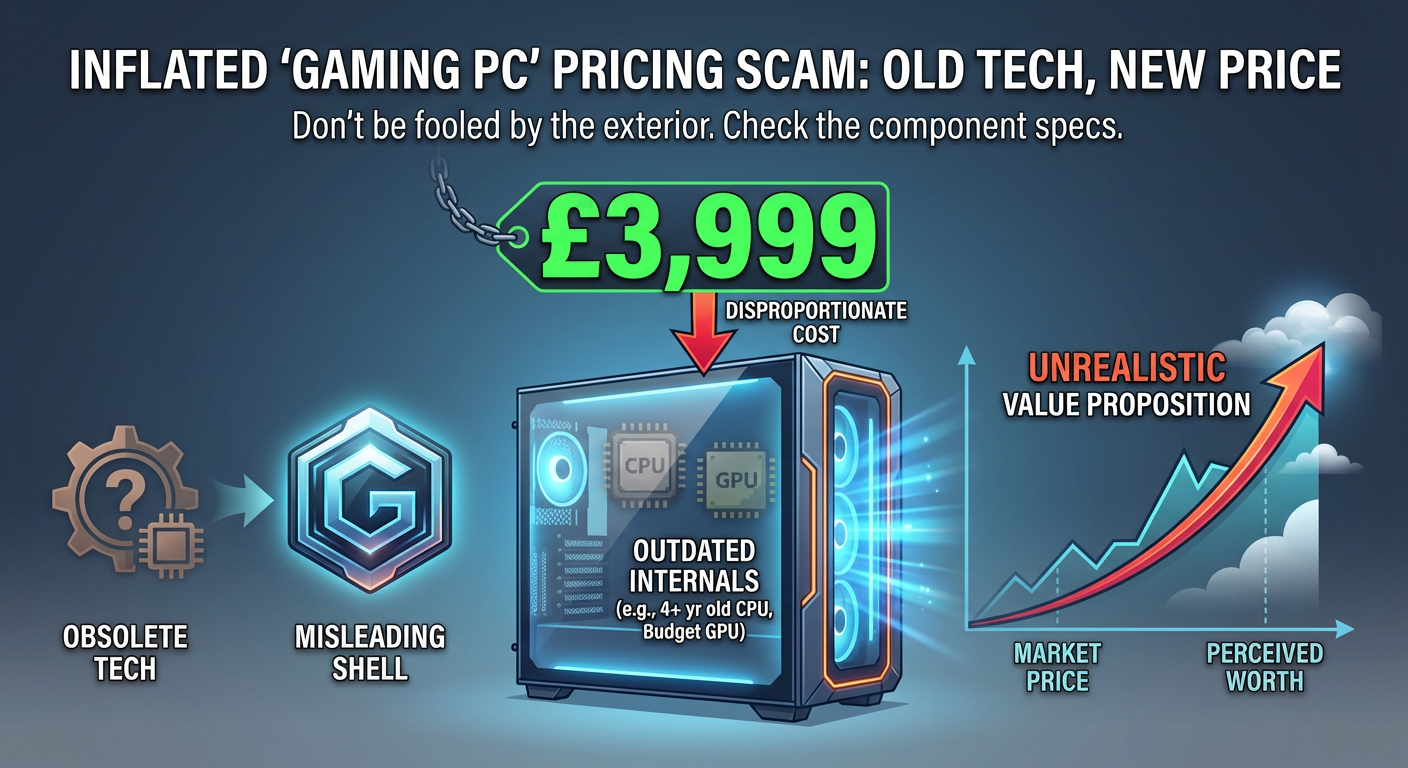
3. Exaggerated Pricing and Astronomical Markups
The burgeoning market for “gaming PCs” constructed from older, refurbished components presents a significant challenge to consumer confidence and transparency, particularly within the UK. While the re-use of electronic waste can offer environmental benefits, the commercial practices underpinning these machines often involve egregious price inflation. Sellers leverage a combination of misleading marketing tactics, the aesthetic appeal of modern PC cases, and a general lack of technical knowledge among significant portions of the consumer base to sell outdated hardware at prices vastly disproportionate to its actual second-hand value [44]. This section rigorously analyses the profound discrepancies between the inherent worth of the recycled components and the exorbitant retail prices fetched by these supposedly “new” or “gaming-ready” systems, effectively demonstrating the astronomical profit margins realised by such sellers.
3.1 The Drastic Disconnect: Used Component Value vs. Retail Price
At the heart of the issue is the gulf between what a savvy buyer would pay for individual, used PC components and the price these pre-built systems command. A critical case from Spain, which serves as a stark illustration of this global phenomenon, highlights a purchaser who paid a staggering €1,200 for a “new” gaming PC. Upon inspection, the machine was found to contain an Intel Core i5-2500 processor, a chip originally released in 2011, paired with an Nvidia GTX 1660 Ti graphics card from 2019 [1]. The combined second-hand market value for these core components, along with other likely aging peripherals, was estimated to be under €300 [6]. This represents a markup exceeding 300% on the intrinsic value of the hardware, effectively rendering the system approximately four times overpriced [23]. With €1,200, the buyer could have acquired a genuinely new and significantly more powerful gaming PC featuring a modern Ryzen 7 5800X CPU and an RTX 4060 Ti GPU, offering exponentially superior performance [24].
Similar patterns of overpricing are readily observable in the UK market. On e-commerce platforms like OnBuy.com, one listing for an “Ultra Fast Gaming PC” bundle was offered at £714.99. The specifications included a “refurbished Intel i5 2nd Gen” processor, 16GB of older DDR3 RAM, and an Nvidia GTX 1660 GPU [12]. Again, the “2nd Gen” designation for the CPU immediately flags it as a component from 2011. While the inclusion of a GTX 1660 is relatively more contemporary (released ~2019), it is still paired with a CPU that would heavily bottleneck its performance, reducing its effective gaming capability [43]. The true second-hand value of such a configuration, even with the GTX 1660 factoring in, would be considerably lower than the £714.99 asking price, especially when considering the refurbished and aged nature of most other components. The market for gaming PCs on eBay UK alone boasts over 41,000 listings at any given time, many of which are refurbished office PCs upgraded with RGB fans and rebranded for gaming, demonstrating the vast scale of this practice [8].
Industry observations further corroborate these findings. A Reddit user documented a system featuring a 12-year-old Intel Core i7-3770 (released in 2012) being sold for $550. Comparable used systems, often with superior graphics cards, were available for approximately $200 [7]. This translates to an astounding 175% premium charged simply for a flashy case and integrated RGB lighting, a phenomenon commonly referred to as the “RGB tax” [10].
| Component/System | Actual Resale Value (Estimated) | Advertised Price (Example) | Era of CPU/GPU | Approximate Markup |
|---|---|---|---|---|
| Spanish “Gaming PC” (i5-2500, GTX 1660 Ti) | <€300 | €1,200 | CPU: 2011; GPU: 2019 | 300% (4x overpriced) |
| OnBuy UK “Ultra Fast” PC (i5-2nd Gen, GTX 1660) | £200-£300 | £714.99 | CPU: 2011; GPU: 2019 | ~138% – 257% |
| Reddit Example (i7-3770 + basic GPU) | ~$200 | $550 | CPU: 2012 | 175% |
3.2 The Allure of Aesthetics and the “RGB Tax”
A key factor enabling these exaggerated prices is the strategic deployment of aesthetics over actual performance. Sellers understand that many less technically inclined buyers equate a flashy appearance with high-end capabilities. Modern PC cases, often featuring tempered glass side panels, multiple RGB LED fans, and aggressive “gamer” styling, are relatively inexpensive to source compared to high-performance internal components. These cosmetic enhancements create an illusion of cutting-edge technology, diverting attention from the underlying outdated hardware [11].
The concept of an “RGB tax” has been identified by tech experts, illustrating how consumers often pay a significant premium for visual flair rather than functional improvements. Tom’s Guide highlighted that a visually striking gaming rig, such as an Alienware Aurora, could cost hundreds of pounds more than a functionally equivalent, but aesthetically “boring,” Dell desktop [10]. In the context of these old-internal gaming PCs, this “RGB tax” is amplified; buyers are paying a substantial premium for lights and windows on systems whose core components are often over a decade old. This marketing sleight-of-hand capitalises on the assumption that a visually impressive machine must also be a high-performing one, preying on a knowledge gap among consumers. Spending an additional £20 on attractive lighting and case fans can allow a seller to inflate the price by hundreds of pounds, a highly lucrative strategy [16].
3.3 The Exploitation of Component Ambiguity: “Core i7” vs. Generational Performance
Another powerful tactic employed by sellers to justify inflated prices is the use of vague or misleading component descriptions. Phrases like “Core i7 Gaming PC” or “16GB RAM” are used to project an image of power and modernity, without specifying the crucial generational information that indicates true performance [4]. For an uninformed buyer, a “Core i7” sounds impressive, regardless of whether it’s a 2011-era i7-2600 or a contemporary i7-14700K. The reality is that an older 3rd-generation Core i7, such as the i7-3770, can be dramatically slower than a modern, entry-level Core i3 or i5 processor, both in single-core performance (critical for many games) and multi-threaded applications [13].
This deliberate ambiguity extends to graphics cards, where sellers might advertise “4GB graphics” without mentioning the GPU model or its generation. A 4GB GeForce GT 730, for example, is an entry-level card incapable of modern gaming, yet “4GB” might sound substantial to a novice [14]. Omitting the exact CPU model, GPU model, RAM type (e.g., DDR3 vs. DDR4/DDR5), and the brand of crucial components like the power supply unit (PSU) are common red flags in such listings. Legitimate sellers will almost always provide these details clearly and prominently. The reliance on generic offers like “Ultra Fast,” “VR Ready,” or “4K HDMI” (despite the GPU being incapable of handling these tasks) further serves to distract buyers from critical performance metrics and inflate perceived value [15].
3.4 Supply-Side Advantages: Cheap Components, High Margins
The viability of these highly profitable ventures stems from a readily available and extremely inexpensive supply of older hardware. Businesses continually upgrade their IT infrastructure, leading to a consistent surplus of decommissioned office PCs. These machines, often equipped with 2nd to 7th generation Intel Core CPUs, DDR3 RAM, and basic motherboards, are acquired for pennies on the pound from IT liquidators or e-waste recyclers. A Core i5-2400 processor, a common component in these refurbished builds, launched in January 2011 and can be purchased today for £5 – £10 on eBay [26].
By pairing such a low-cost CPU with other salvaged components – an older mid-range GPU (like a GTX 750 from 2014 or even a GTX 1660 from 2019, which itself is now relatively affordable on the used market), a cheap generic PSU, and an inexpensive modern case – sellers can assemble a system for a total component cost potentially as low as £200. The £714.99 OnBuy example, which bundled an i5-2400, 16GB DDR3 RAM, a GTX 1660, and a refurbished 19-inch monitor, highlights this [27]. The potential profit margin on a system where component costs are approximately £200-£300 and the retail price is £600-£800 is considerable, driving a significant portion of this market segment. These profit margins can reach 200-300% on the cost of materials alone.
| Component | Estimated Market Value (Used/Cheap New) in GBP |
|---|---|
| CPU (e.g., i5-2400/i7-2600) | £10 – £30 |
| Motherboard (LGA 1155/1150) | £20 – £50 |
| RAM (16GB DDR3) | £20 – £40 |
| GPU (e.g., GTX 750/GTX 1660) | £30 – £100 (GTX 750) / £80 – £150 (GTX 1660) |
| Storage (Used SSD/HDD) | £15 – £40 |
| Case (Entry-level RGB) | £30 – £60 |
| PSU (Generic, low-quality) | £15 – £30 |
| Total Estimated Component Cost | £140 – £400 |
| Typical Advertised Price (UK) | £500 – £1000+ |
| Potential Profit Margin (per unit) | ~£360 – £900+ |
The GPU shortage between 2020 and 2022 further boosted this business model. With new graphics cards being scarce and prohibitively expensive, companies like Alarco, established around 2019, capitalised by recycling older GPUs and integrating them into budget gaming PCs [28]. This established a market for these outdated builds, and even after GPU prices normalised, the practice continued due to sustained demand and the embedded profitability.
3.5 The Unseen Cost: Hidden Issues and Upgrade Dead-Ends
Beyond the immediate financial markup, buyers of these systems face numerous hidden costs and performance limitations. The combination of an outdated CPU (e.g., an Intel i5-2500) with a relatively newer GPU (e.g., a GTX 1660 Ti) creates a significant performance bottleneck. Research indicates that an i5-2500 can bottleneck a GTX 1660 Ti by approximately 35% in gaming scenarios, meaning the GPU’s potential is never fully realised [22]. This renders any perceived value of the graphics card largely moot.
Furthermore, these systems are typically built on legacy platforms, using older motherboard chipsets and DDR3 RAM. This severely limits future upgrade potential. To move to a modern CPU, an entirely new motherboard and faster DDR4 or DDR5 RAM would be required, along with a compatible power supply. As one review of an Alarco PC bluntly stated, any meaningful upgrade would involve “replacing every single part” [11]. Power supplies in these systems are often cheap, unbranded units lacking crucial safety features, posing a risk to other components and themselves typically being insufficient for any future, more powerful GPU upgrades.
A significant, often overlooked, compatibility issue for Intel 2nd to 7th generation CPUs is their official inability to support Windows 11. These older chips lack necessary features such as TPM 2.0. This means buyers are effectively locked into Windows 10, an operating system whose support is slated to end in October 2025 [9]. This impending end-of-life status adds a critical layer of hidden cost and potential security risk, as users may eventually be forced to either operate an unsupported OS or undertake a complete platform upgrade sooner than anticipated, further devaluing their initial “investment.”
3.6 Conclusion to Exaggerated Pricing
The phenomenon of selling old computer internals at exorbitant prices in new, flashy cases represents a considerable breach of consumer trust and a testament to the effectiveness of deceptive marketing. In the UK market, as elsewhere, unwary buyers are lured by attractive aesthetics and misleading specifications, paying premiums of 150% to 300% or more for systems that offer dramatically subpar performance, limited longevity, and zero upgrade potential. The availability of cheap, discarded hardware and the consumer’s knowledge gap fuel this lucrative, albeit ethically questionable, cottage industry. For the consumer, understanding these predatory pricing strategies and the tangible value of PC components is paramount to avoiding what essentially amounts to an overpriced, underperforming digital trap.

4. Marketing Tactics: The ‘RGB Tax’ and Misleading Specifications
In the vibrant, fast-paced world of PC gaming, the allure of a powerful machine capable of rendering stunning virtual landscapes and delivering seamless gameplay is undeniable. For many, particularly those new to the hobby or shoppers on a budget, the ideal gaming PC must not only perform well but also look the part. This desire for aesthetics, coupled with a general lack of in-depth technical knowledge among a significant portion of consumers, has created a fertile ground for sophisticated marketing tactics employed by less scrupulous sellers. These tactics often involve leveraging flashy RGB (Red, Green, Blue) lighting, vague or misleading component descriptions, and an overemphasis on peripheral features to distract buyers from the fundamentally outdated internal hardware driving these “gaming” systems. This section delves into the psychological and commercial strategies that allow vendors to sell second-hand, often decade-old, computer internals at inflated prices, repackaged within modern, aesthetically pleasing cases. We will examine the phenomenon of the ‘RGB Tax’, the cunning use of generic “Core i7” labels, and other deceptive practices that collectively contribute to poor value propositions for unsuspecting buyers in the UK and beyond.
4.1. The Allure of Aesthetics: The ‘RGB Tax’ Phenomenon
The modern gaming PC aesthetic is heavily influenced by RGB lighting. Tempered glass side panels, illuminated fans, and glowing internal components have become synonymous with high-performance gaming rigs. This visual appeal, however, often comes at a steep price, both literally and figuratively. The concept of the “RGB tax” refers to the premium buyers pay for these aesthetic enhancements, often at the expense of actual processing power or graphical capability. Experts note that many “flashy ‘gaming’ PCs charge a premium for aesthetics without adding performance”12. This phenomenon is particularly prevalent in the market for systems assembled from older components, where sellers strategically invest in cheap visual upgrades to mask deeper deficiencies.
A Tom’s Guide analysis highlighted that consumers could save “hundreds of pounds” by opting for a “boring” system with equivalent functional specifications lacking the RGB flair12. This suggests that the cost of RGB lighting and aggressive styling, when applied to a system built with antiquated parts, represents an even more egregious markup. In these scenarios, the premium is not just for aesthetics but also a deliberate diversion from the true value of the underlying hardware. The total cost of RGB components – fans, LED strips, and illuminated chassis elements – is relatively low for sellers, likely around £20 or £30 per unit. Yet, this minor investment allows them to charge hundreds of pounds more, creating a lucrative profit margin of 200-300% on a product that is functionally inferior to a similarly priced, but less flashy, new system23.
This marketing strategy plays on less tech-savvy shoppers who equate sophisticated looks with superior performance. The external appearance – featuring tempered glass, multiple RGB fans, and aggressive “gamer” styling – cultivates an illusion of a powerful machine24. However, beneath this visually striking exterior, the systems are often powered by components that struggle to cope with contemporary software demands.
4.1.1. Case Studies in RGB Deception
One notable example is the US-based company Alarco, which built its business model around repackaging older hardware. Their “gaming” PCs, typically priced around $450-$500, uniformly incorporate 2011 Intel CPUs (such as the Core i5-2400 or i7-2600) and 2012-2014 GPUs (like the GTX 650 or GTX 750)2. A common feature across Alarco’s offerings is the inclusion of six RGB fans, turning a system with an average second-hand component value of £200-£300 into a product sold for £600-£800. This stark contrast highlights how a minor investment in aesthetics can yield substantial profit margins for the seller.
In the UK, the prevalence of such tactics is equally apparent. eBay UK alone hosts over 40,000 “gaming PC” listings at any given time6. Many of these are refurbished office PCs upgraded with RGB fans and aggressive outward styling. For instance, a listing on OnBuy.com offered an “Ultra Fast Gaming PC” bundle for £714.99, despite featuring a refurbished Intel i5 2nd Gen processor and 16GB of older DDR3 RAM5. The package was further sweetened with a used 19-inch monitor, gaming keyboard, and mouse, alongside the requisite RGB-lit case33. These bundles are designed to appear as comprehensive and high-value deals, with the flashy case and peripherals serving to distract from the core components’ antiquity.
The psychological impact of RGB is significant. For consumers who are not deeply immersed in PC hardware specifics, the presence of vibrant lighting and sleek designs can be a powerful indicator of modernity and performance. This makes them vulnerable to sellers who understand that appearance can often outweigh substance in the eyes of an uninformed buyer.
4.2. Misleading Specifications: The Vague ‘Core i7’ Label and Other Euphemisms
A key component of the deceptive marketing strategy is the intentional vagueness and selective emphasis in product specifications. Sellers deliberately omit critical details that would reveal the outdated nature of the components, instead highlighting generic terms or high-level attributes that sound impressive to the uninitiated.
4.2.1. The “Core i7” Fallacy
Perhaps the most egregious example is the liberal use of processor labels such as “Core i7” or “Core i5” without specifying the generation. To the average consumer, “Core i7” signifies a top-tier processor from Intel. However, Intel’s Core i-series processors have evolved through numerous generations since their introduction. A Core i7 from 2011, such as the i7-2600, is vastly different in performance from a Core i7 from 2023 or 2024. The former, for instance, launched in 2011, making it nearly 14 years old today39, whereas the latter offers multiple folds of performance improvement due to advancements in architecture, core count, and clock speeds.
Sellers capitalise on this knowledge gap. They will advertise “Core i7 Gaming PC” or “Intel Core i5 Ultra Fast” to evoke a sense of high performance, without explicitly stating that it’s a 2nd, 3rd, or 4th generation chip. For example, a system with a “12-year-old Core i7-3770” was listed for $550, even though comparable used PCs typically sell for around $2004. This represents an approximate 175% markup, largely attributable to the “Core i7” label and flashy aesthetics7. A Reddit user pointed out a listing using an i7-3770 (over 10 years old) and marketing it as if it were cutting-edge technology14.
The psychology at play here is simple: consumers are generally aware that an “i7” is superior to an “i5,” and an “i5” is better than an “i3.” However, they often lack the granular knowledge to understand that a modern Core i3-12100 (a recent budget CPU) can significantly outperform a decade-old Core i7-3770. Sellers exploit this “halo effect of legacy high-end labels”24, presenting what was once a premium component as if it still holds that status relative to current technology.
4.2.2. Selective Specification Disclosure
Beyond the CPU, other specifications are often presented in a similarly misleading manner. Listings frequently boast “16GB RAM!” or “4GB graphics!” without detailing the crucial aspects of these components. For instance:
- RAM: While 16GB of RAM might sound like a lot, sellers rarely specify whether it’s DDR3 or DDR4, let alone its clock speed. Old systems invariably use DDR3 RAM, which is significantly slower and less efficient than modern DDR4 or DDR5 standards. More importantly, older motherboards using DDR3 have a limited upgrade path.
- GPU VRAM: The amount of VRAM (dedicated graphics memory) on a GPU is often highlighted (e.g., “4GB GPU”). However, this number alone is a poor indicator of performance. A 4GB NVIDIA GT 730 (a very low-end card from 2014) is advertised as if it competes with a 4GB RTX 3050 (a much newer and more powerful card). One egregious example involved an Atlanta computer shop advertising a “GTX 550 Ti 6GB” – a card from 2011 typically with 1GB VRAM, suggesting a deliberate attempt to misrepresent its capabilities34. These GPUs often “cannot run recent AAA titles smoothly”10.
- Hard Drive Size: Large storage capacities, like “1TB HDD,” are often advertised, ignoring the performance implications of using an older Hard Disk Drive (HDD) instead of a solid-state drive (SSD), which offers vastly superior speed for system responsiveness and game loading.
The deliberate omission of specific model numbers, generations, and critical performance metrics is a calculated move to prevent informed comparison. A legitimate seller would list the exact CPU model, GPU model, RAM type/speed, and ideally, the PSU brand27. When these details are buried in fine print or entirely absent, it raises a significant red flag.
4.2.3. Use of Semi-True Buzzwords and Feature Padding
Further padding the perceived value, sellers frequently employ buzzwords that, while technically true, are irrelevant to gaming performance or are standard features. Phrases like “VR Ready” or “4K HDMI” may be used even when the old GPU would struggle to game at 4K or handle VR experiences effectively24. Other common additions include:
- “WiFi Ready” or “Wireless Connectivity”: This is a basic feature expected in almost any modern PC, yet it’s listed as an added benefit.
- “Windows 10 Pro Installed”: While including an operating system is standard, highlighting the “Pro” version often implies a premium feature that has little to no impact on gaming performance for the typical user. Crucially, as Windows 10 reaches its end-of-life in 2025, the lack of Windows 11 compatibility due to older CPUs (2nd-7th gen Intel) leaves buyers with a ticking clock on OS support8.
- “Gaming Keyboard and Mouse Included”: While a welcome addition for some, these peripherals are typically low-cost, generic items that add minimal value but serve as a perceived bonus in a bundle, particularly in UK listings such as the OnBuy example33.
These tactics shift the buyer’s focus from the core performance components to peripheral features, inflating the perceived value without improving actual gaming capability.
4.3. Consequences for the Unwary Consumer: Performance, Compatibility, and Hidden Costs
The marketing strategies described above lead directly to significant negative consequences for consumers who purchase these types of PCs. These systems often deliver a subpar experience, have limited longevity, and can incur hidden costs.
4.3.1. Lacklustre Gaming Performance
The most immediate and frustrating consequence is the poor gaming performance. Buyers expecting to run modern AAA titles often find them “unplayable or needing low settings”25. A GTX 750 or similar GPU bundled with these systems frequently cannot sustain frame rates of 30-60 FPS in recent games at 1080p11. Even eSports titles or older games might stutter when paired with an antiquated CPU. For example, a 2011 Core i5 CPU coupled with a GTX 750 can only handle older or less demanding games, achieving around 60 FPS in titles like Rocket League at 1080p, a stark contrast to a modern $500 gaming PC that could run popular games at high settings with consistent 60+ FPS9.
The Alarco review explicitly states that these PCs “won’t handle today’s AAA games,” and even relatively light games pose a challenge on their outdated GPUs23. This disparity between advertised capability (implied by “gaming PC” and flashy looks) and actual performance creates significant user dissatisfaction.
4.3.2. Windows 11 Incompatibility and Software Limits
A severe limitation of these older-generation systems is their incompatibility with modern operating systems. All Intel CPUs older than 8th generation (and AMD pre-Ryzen 2000) do not meet the hardware requirements for Windows 11, primarily due to the absence of TPM 2.0 and newer security features26. This means that 100% of these 2nd-7th generation Intel-based PCs are officially stuck on Windows 108.
While Windows 10 is currently functional, official support from Microsoft is slated to end in October 2025. This introduces significant “security and compatibility concerns” for buyers, who might be forced into an expensive full platform upgrade sooner than anticipated just to maintain a supported operating system. Furthermore, many modern games and applications are optimised for newer instruction sets (like AVX2) found in contemporary CPUs, leading to sub-optimal performance or outright incompatibility on older processors.
4.3.3. Severely Limited Upgrade Path
These systems are often built on legacy platforms featuring outdated DDR3 RAM, older CPU sockets (e.g., LGA 1155 for 2nd/3rd gen Intel, LGA 1150 for 4th gen), and motherboards with limited upgrade options. A meaningful upgrade is often impossible without replacing multiple core components simultaneously. As one analysis noted, an upgrade for such a refurb gaming PC typically means “replacing every single part” – effectively starting from scratch15.
Common bottlenecks and issues include:
- Motherboard limitations: The motherboard socket limits CPU upgrades to a narrow range of similarly aged processors.
- RAM incompatibility: Older DDR3 RAM is incompatible with newer motherboards and CPUs that require DDR4 or DDR5.
- Power Supply Unit (PSU) inadequacies: Many of these builds skimp on the PSU, using cheap, unbranded units that are often insufficient or unreliable for a more powerful, modern GPU.
- Case design: Even the flashy RGB cases might have poor airflow or non-standard internal layouts, complicating the installation of newer, larger components.
This “upgrade dead-end” means any perceived short-term savings quickly evaporate when the buyer needs to overhaul the entire system, incurring costs for a new CPU, motherboard, RAM, GPU, and potentially even an OS license.
4.3.4. Higher Risk of Failure and Hidden Costs
The use of refurbished, aged components inherently increases the “likelihood of hardware failure”29. Capacitors on a 10-year-old motherboard are closer to their end-of-life, and mechanical hard drives may have accumulated years of wear. The inclusion of generic, low-quality power supplies further exacerbates this risk, as they are prone to malfunction and can potentially damage other components.
A Spanish case highlighted in 2025 detailed a father who paid €1,200 for a gaming PC containing an Intel Core i5-2500 (2011) and an Nvidia GTX 1660 Ti (2019)1. The combined second-hand value was under €300, making the system approximately four times overpriced1. This illustrates how buyers effectively “pay twice”: first, an inflated price for a supposedly gaming-capable PC, and then again for the necessary upgrades when the initial system proves inadequate. Moreover, pairing an old CPU like the i5-2500 with a relatively newer GPU like the GTX 1660 Ti results in significant CPU bottlenecking, by as much as 35% in games30, which means the GPU’s potential is never fully realised.
These hidden disadvantages and associated costs transform what initially appears to be a bargain into a costly lesson in consumer vigilance.
4.4. Implications and Consumer Awareness
The widespread nature of these practices, particularly visible on UK marketplaces like eBay with its 41,979 “Gaming Computer” listings9, underscores a significant gap in consumer awareness. Thousands of buyers, often parents or first-time gamers, fall prey to these marketing ploys, as evidenced by the 4,500+ reviews for Alarco’s products on Amazon, which maintain an average 3.8-star rating despite their outdated components8. This suggests that many purchasers are either unaware of the true value and performance limitations or are swayed by the perceived budget accessibility and aesthetic appeal.
The lesson from the Spanish father’s €1,200 purchase highlights the clear need for consumers to consult “tech experts or online forums” before making such significant hardware investments37. Without external guidance, the average consumer struggles to evaluate complex technical specifications. The market effectively preys on this lack of knowledge by using flashy marketing and ambiguous terminology.
In conclusion, the marketing tactics employed by sellers of these “RGB gaming PCs” are deeply rooted in exploiting information asymmetry. By packaging obsolete internals in appealing, RGB-laden cases and using deliberately vague or misleading specifications, they create an illusion of value and performance that often leads to disappointment and financial waste for the end-consumer. Understanding these tactics is the first step towards fostering greater consumer protection and promoting more informed purchasing decisions in the PC gaming market.
The prevalence of these marketing strategies and the resulting consumer detriment necessitate a deeper examination of the mechanisms that enable such widespread deception. The next section will explore the role of online marketplaces and the regulatory landscape in the UK and how they either facilitate or hinder the proliferation of these misleading sales practices.
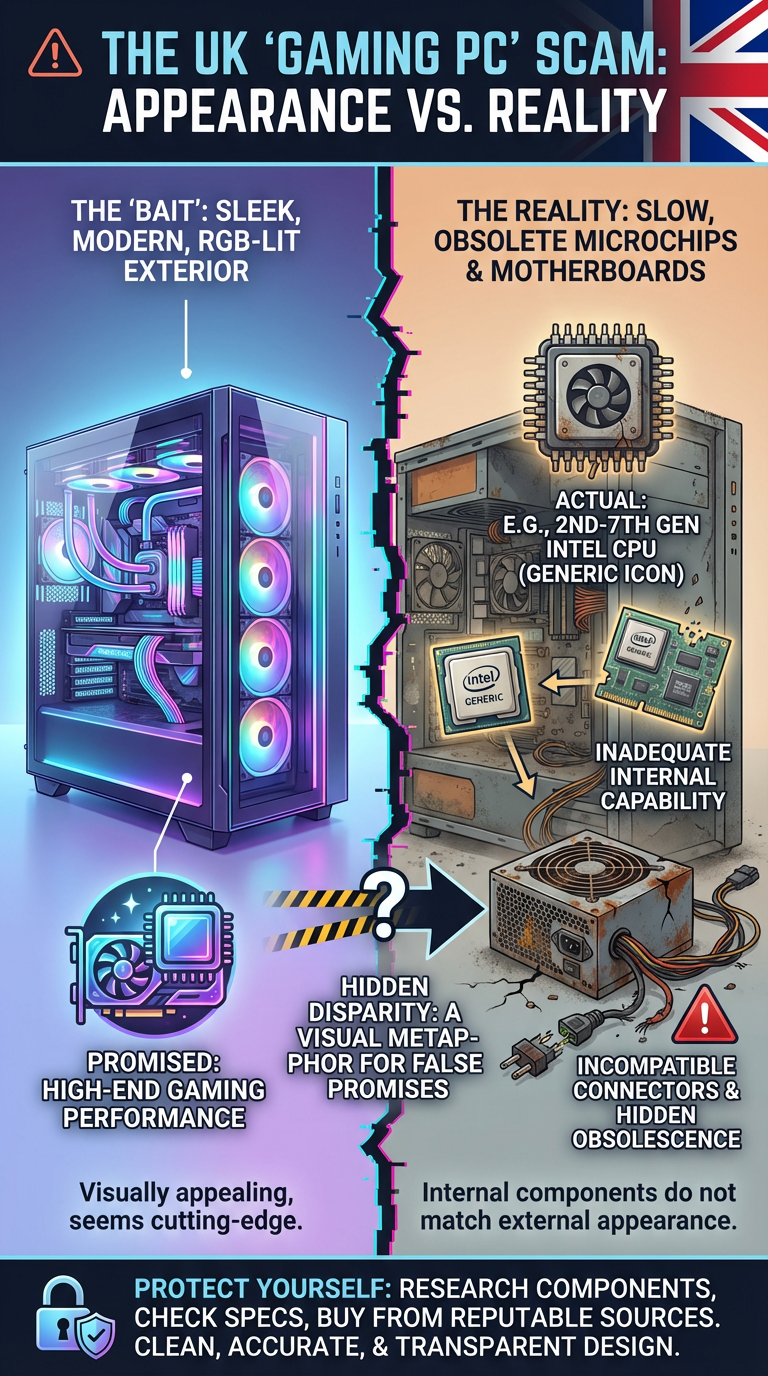
5. Performance Deficiencies and Compatibility Challenges
The burgeoning market for “gaming PCs” comprising repackaged, obsolete computer internals presents a significant challenge to consumer trust and value, specifically within the UK landscape. While these systems are often marketed with flashy aesthetics, such as RGB lighting and modern-looking cases, their underlying hardware frequently dates back a decade or more. This mismatch between exterior presentation and internal capability leads to severe performance deficiencies, a host of compatibility issues, and ultimately, a profoundly unsatisfactory user experience. For unsuspecting consumers, particularly those less tech-savvy, the allure of an outwardly impressive “gaming” machine at an ostensibly affordable price masks critical limitations that render these PCs ill-equipped for contemporary gaming and software requirements, creating not just performance bottlenecks but also incurring hidden future costs and dead-end upgrade paths.
The phenomenon is widespread. On online marketplaces like eBay UK, over 40,000 “gaming PC” listings are active at any given time, many of which are refurbished office PCs upgraded with RGB fans to create the illusion of a high-performance gaming rig [9]. Brands like Alarco, based in the U.S., have built entire business models around repurposing 2011-era Intel CPUs and 2012-2014 GPUs, successfully amassing thousands of reviews despite the outdated specifications [2] [4]. This widespread availability and apparent consumer acceptance highlight a critical gap in consumer awareness regarding technical specifications and their real-world implications, resulting in buyers paying significant markups for hardware that offers a fraction of modern performance.
5.1. Severe Limitations in Gaming Performance
The primary appeal of a “gaming PC” lies in its ability to smoothly render interactive digital entertainment. However, systems built with internals from the 2nd to 7th generation of Intel processors, coupled with companion GPUs from the same era, consistently fail to deliver a satisfactory experience for modern AAA titles. This performance deficit is not merely a matter of reduced graphics settings; it often means certain games are fundamentally unplayable or severely comofferd.
5.1.1. Inadequate CPU Performance
Many of these “gaming PCs” come equipped with CPUs well over a decade old. For instance, Intel Core i5-2500 (launched 2011) and Core i7-3770 (2012) are frequently found in these builds [1] [5]. While these processors were top-tier in their day, their architectural limitations, core counts, and instruction sets are woefully insufficient for modern gaming workloads. Contemporary games, especially open-world titles or those featuring complex physics and AI, are increasingly multithreaded and demand robust single-core performance. A 2011-era Core i5 or i7, despite its “i7” branding, struggles significantly to keep up with these demands.
Consider the example of the Intel Core i5-2500, a typical CPU seen in these systems, which launched in January 2011 [2]. Paired with a more modern, yet still mid-range, GPU like an Nvidia GTX 1660 Ti (released 2019), this 14-year-old CPU can cause a significant performance bottleneck. Research indicates that an i5-2500 can bottleneck a GTX 1660 Ti by approximately 35% in games [8]. This means that a relatively capable GPU cannot perform to its full potential because the outdated CPU cannot process game logic and feed data fast enough. The result is lower frame rates, inconsistent frame pacing, and a generally choppy experience even in scenarios where the GPU might otherwise be capable.
Even Intel’s 7th generation processors, such as the i7-7700 (launched January 2017), which are among the “newer” old parts used, are now nearing eight years old and fall below the minimum requirements for future operating systems like Windows 11. These older CPUs lack the modern instruction sets (like AVX2, which some games use for optimizations) and the increased core/thread counts found in current generation processors, which are essential for smooth gameplay in CPU-intensive titles.
5.1.2. Incapable GPU Performance
The graphics processing units (GPUs) employed in these budget gaming PCs are equally, if not more, restricted. Common graphics cards include the Nvidia GTX 650 (2012) or GTX 750 (2014) [2]. While these cards were once respected entry-level or mid-range options, they possess neither the raw horsepower nor the modern features (e.g., advanced DirectX support, hardware ray tracing) required for current-generation games.
A review of Alarco PCs, a prominent seller of such systems, explicitly states that GPUs like the GTX 750 “won’t run modern AAA games at decent settings” [4]. While older or less demanding titles, such as *Rocket League*, might achieve frame rates above 60 FPS at 1080p, “almost any newer game” will overwhelm these GPUs [4]. The experience with graphics-intensive games like *Cyberpunk 2077*, *Starfield*, or even many popular online multiplayer games released in the last five years would be akin to a slideshow, even at the lowest graphical settings and reduced resolutions.
The disparity in performance is stark when compared to genuinely budget-friendly modern gaming PCs. For example, a new PC costing around £500-£600, perhaps with a GTX 1660 Super or an RTX 3050 (when available), would comfortably run popular titles at high settings with 60+ FPS [10]. In contrast, a £714.99 “Ultra Fast” gaming PC advertised on OnBuy.com featured a 2nd Gen Intel i5 and a GTX 1660 [6]. While the GTX 1660 is a more recent GPU (released 2019) than the 750-series, pairing it with such an ancient CPU creates a severe bottleneck, effectively wasting the GPU’s potential and making the system dramatically overpriced for its real-world gaming capability.
5.2. Critical Compatibility Issues and Future Costs
Beyond immediate performance inadequacies, these systems are plagued by critical compatibility issues, primarily with operating systems, which lead to significant hidden costs and a limited lifespan for the hardware.
5.2.1. Windows 11 Incompatibility
One of the most pressing compatibility problems concerns the operating system. Microsoft’s Windows 11, released in 2021, has stringent hardware requirements that exclude older processors. Specifically, Intel CPUs older than the 8th Generation (e.g., Core i7-8xxx series) are officially unsupported [5]. This means that 100% of the “gaming PCs” built with 2nd to 7th generation Intel chips are officially unable to run Windows 11.
This leaves buyers operating on Windows 10, an operating system that will reach its end-of-life (EOL) in October 2025. After this date, Windows 10 will no longer receive free security updates, making affected systems vulnerable to new exploits and threats. Users will then face a difficult choice: continue using an insecure operating system, pay for extended security updates (if available for consumers), or undertake an expensive platform upgrade involving a new CPU, motherboard, and RAM, effectively replacing the entire core of the PC. This situation constitutes a significant hidden cost that is rarely disclosed in the advertisements of these older-hardware gaming PCs.
The lack of Windows 11 support also means these systems miss out on potential performance enhancements and new features integrated into the latest operating system, further widening the gap between them and truly modern gaming experiences.
5.2.2. Obsolete Platform and Zero Upgrade Path
The motherboards and chipsets used in these 2nd to 7th generation Intel PCs are based on outdated platforms, such as those supporting DDR3 RAM (e.g., LGA 1155 for 2nd/3rd Gen or LGA 1151 for 6th/7th Gen). This creates an upgrade dead-end for consumers.
* **Limited CPU Upgrades:** The CPU socket on these motherboards only supports a narrow range of processors within that specific generation. For example, a motherboard designed for a 2nd Gen Intel CPU cannot accept an 8th Gen or newer chip. Even if a user wanted to upgrade their Core i5-2500 to a Core i7-2600, the performance gain would be minimal and wholly insufficient for modern demands.
* **Outdated RAM:** The prevalent use of DDR3 RAM means that future upgrades would necessitate a complete platform overhaul to support faster DDR4 or DDR5 memory, as current generation CPUs and motherboards exclusively use these newer standards. This means any investment in additional DDR3 RAM is a short-term, inefficient solution.
* **Generic Components and Poor Power Supplies:** These systems often cut corners on non-flashy components. They typically feature cheap, unbranded power supplies (PSUs) that might lack sufficient wattage, stability, or safety protections for a serious gaming setup. Upgrading to a more powerful GPU often requires replacing the PSU, adding another unforeseen expense. The cases, while flashy, sometimes have poor airflow, causing thermal throttling and reducing component lifespan. As one review plainly stated about Alarco PCs, any meaningful upgrade “involves replacing every single part” of the system [4]. This effectively renders the initial purchase a sunk cost if the user desires a truly capable machine in the future.
This upgrade inflexibility means that purchasers of these systems are locked into a severely limited hardware ecosystem. Any aspirations for future performance improvements will require a complete rebuild, negating any perceived “savings” from the initial purchase and leading to a much higher total cost of ownership.
5.3. Poor User Experience and Bottlenecks
The combination of outdated CPUs, underpowered GPUs, and architectural limitations culminates in a consistently poor user experience, making the shiny exterior and “gaming PC” branding a deceptive facade.
5.3.1. General System Responsiveness
Beyond gaming, the general responsiveness of these systems can be subpar due to old CPUs and, in some cases, the continued use of mechanical hard drives instead of solid-state drives (SSDs). While some sellers might include an SSD, older CPUs still struggle with general multitasking and demanding modern applications that have grown in complexity, often optimized for newer instruction sets and higher core counts. The experience of simply navigating the operating system, browsing demanding websites, or running productivity software can be frustratingly slow compared to a contemporary PC.
5.3.2. Exacerbated Bottlenecks
The practice of pairing relatively newer, but still mid-range, GPUs (like the GTX 1660 Ti or GTX 1660) with extremely old CPUs (like the i5-2500 or i7-3770) creates significant performance bottlenecks. As previously noted, a 35% bottleneck of a GTX 1660 Ti by an i5-2500 is a substantial reduction in efficiency [8]. Such a drastic bottleneck means that players are not experiencing the full potential of even the slightly more capable GPU component, leading to wasted potential and disappointing in-game performance that does not reflect the GPU’s listed specifications. This not only frustrates gamers but also makes the cost of the “newer” GPU component in the system even harder to justify, as it cannot be fully utilized.
5.3.3. Increased Failure Risk
The fact that many components within these systems are either old, refurbished, or second-hand directly translates to a higher risk of hardware failure. Capacitors on a 10-year-old motherboard are much closer to their end-of-life than brand-new components. Similarly, mechanical hard drives, if present, likely have years of operational wear and tear, making them susceptible to failure. Cheap, generic power supplies are notorious for premature failure, and in some unfortunate cases, can damage other components when they fail. This higher failure rate compounds the poor user experience, potentially leading to data loss, unexpected downtime, and further costs for repairs or replacements, often outside of any limited warranty provided by the reseller.
5.4. The “RGB Tax” and Deceptive Marketing
The phenomenon of overpriced, underperforming “gaming PCs” is heavily reliant on deceptive marketing tactics, often leveraging superficial aesthetics over genuine performance. This has been termed the “RGB tax,” where consumers pay a premium for visual flair rather than computational power [7].
5.4.1. Aesthetics Over Performance
Sellers of these systems strategically invest in flashy cosmetic features: clear side panels, multiple RGB fans, aggressive case designs, and bright LED strips. These elements create an illusion of a high-performance gaming rig, appealing to less informed buyers (e.g., parents buying for children, or first-time PC gamers on a budget) who equate fancy looks with cutting-edge technology. Tom’s Guide explicitly notes that purchasers can “save hundreds” by foregoing RGB components, as the premium paid for aesthetics does not translate to improved performance [7]. In the context of these old-hardware builds, the “RGB tax” becomes even more egregious, as the aesthetic investment serves to mask severely outdated internals.
5.4.2. Misleading Specification Terminology
Advertisements frequently employ intentionally vague or misleading language when listing specifications:
- Generic CPU/GPU Labels: Listings often tout “Intel Core i7” or “16GB RAM” without specifying the crucial generation or exact model numbers (e.g., an “Intel Core i7-2600” vs. a modern “Intel Core i7-14700K”). This exploits the common knowledge that “i7” is generally powerful, but obfuscates the fact that a 2nd Gen i7 is vastly inferior to a current-gen i3 or i5 [5]. Similarly, a “4GB graphics card” might sound impressive, but it could refer to an ancient GeForce GT 730, which has negligible gaming performance [11].
- Emphasis on Secondary Features: Ads often prominently feature non-performance specifications such as “Wi-Fi Ready,” “Windows 10 Pro Installed,” or bundled generic peripherals (keyboard, mouse, used monitor) to pad the value proposition and distract from the core component inadequacies [6].
- Exaggerated Capabilities: Phrases like “Ultra Fast Gaming PC” [6] or claims of being “VR Ready” are sometimes used even when the underlying hardware is demonstrably incapable of delivering such experiences. For instance, a system with a GTX 1660 alongside a 2nd Gen Intel i5 CPU can barely deliver a smooth 1080p gaming experience for many modern titles, let alone VR.
This deceptive language exploits a “knowledge gap” among consumers, who may not understand the critical importance of component generation or model numbers, relying instead on buzzwords that bear little relation to real-world performance [5]. As a result, thousands of consumers, unaware of the distinction between an old i7 and a new i7, or the true capabilities of a GTX 750, purchase these systems annually, as evidenced by Alarco’s 4,500+ reviews for its budget offerings [2].
This table illustrates the stark difference in specifications and capabilities between a typical old-hardware “gaming PC” and a genuinely modern entry-level gaming PC at a comparable (or even lower) price point:
| Feature | Typical Old-Hardware ‘Gaming PC’ (e.g., Alarco/many eBay UK listings) | Modern Entry-Level Gaming PC (New, Q4 2024 Est.) |
|---|---|---|
| CPU | Intel Core i5-2400 (2011) to i7-7700 (2017) [2] [5] | Intel Core i3-12100F (2022) or AMD Ryzen 5 5600G (2021) |
| GPU | Nvidia GTX 650 (2012) to GTX 750 (2014) or sometimes GTX 1660 (2019) (often bottlenecked) [2] [6] | Nvidia GeForce RTX 3050 (2022) or AMD Radeon RX 6600 (2021) |
| RAM | 8GB-16GB DDR3 (e.g., 1333-1600MHz) | 16GB DDR4 (e.g., 3200MHz) or DDR5 (e.g., 5200MHz) |
| Storage | 1TB HDD or small (120-240GB) used SSD | 500GB-1TB NVMe SSD (new) |
| Operating System Support | Officially stuck on Windows 10 (EOL Oct 2025) [5] | Fully Windows 11 compatible |
| Gaming Performance (1080p AAA Titles) | Poor, often unplayable at even low settings (<30 FPS) [4] | Good to excellent, 60+ FPS at medium to high settings |
| Upgrade Path | Effectively none, requires replacing entire platform (CPU, Mobo, RAM) [4] | CPU and GPU upgrades possible within platform; often socket compatibility for future CPUs |
| Market Value (Used) | ~£200-£300 for comparable components assembled [5] | N/A (as new) |
| Advertised Price (UK) | ~£400-£1200+ (depending on GPU and seller) [1] [6] | ~£500-£700 (for new component builds) |
This comprehensive analysis clearly delineates the profound shortcomings of these “gaming PCs” that rely on outdated internals. The performance deficiencies are so severe that they fundamentally undermine the “gaming PC” designation. Coupled with critical compatibility issues, particularly the looming end-of-life for Windows 10 support on these platforms, and the non-existent upgrade paths, these systems represent a poor and often deceptive investment for UK consumers. The initial high price paid, inflated by aesthetic flourishes, ultimately leads to a frustrating user experience, hidden future expenses, and a rapid obsolescence that could have been avoided with better awareness and more transparent market practices.
The next section will delve into the market dynamics that enable the proliferation of such systems, examining the economic incentives for sellers and the consumer demographics most susceptible to these offerings.
6. Limited Upgrade Paths and Hidden Costs for Buyers
The allure of an affordable “gaming PC” featuring flashy RGB lighting and aggressive aesthetics can be compelling, particularly for budget-conscious consumers in the UK seeking an entry point into PC gaming. However, beneath the superficial appeal of many such systems, which often house 2nd to 7th generation Intel internals, lies a critical and often undisclosed disadvantage: severely limited upgrade paths and significant hidden costs. These machines are frequently built upon antiquated architectures, rendering any meaningful performance upgrade a virtual impossibility without replacing nearly the entire system. This deep dive will explore the dead-end nature of these systems’ upgradeability, scrutinise the increased risk of hardware failure due to aged components, and detail the various hidden financial burdens unwittingly undertaken by buyers.
The Upgrade Dead-End: A Systemic Obsolescence
One of the most significant drawbacks of purchasing these refurbished “gaming PCs” is their inherent lack of future-proofing and upgrade potential. Unlike modern gaming systems designed with architectural flexibility, these older platforms operate on technologies that are generations behind current standards. This creates a systemic obsolescence barrier that effectively traps buyers in a loop of underperformance and necessitates complete system overhaul for any substantial improvement.
Processor and Motherboard Limitations
The foundation of these systems typically rests on Intel CPUs from the 2nd to 7th generation, dating back as far as 2011. For instance, the Intel Core i5-2500, a CPU from 2011, has been observed in a “new” gaming PC sold for €1,200 in 2025[8]. Similarly, vendors like Alarco, a US-based company whose practices are mirrored in the UK market, predominantly utilise Intel Core i5-2400 (launched January 2011) or Core i7-2600 (also 2011) in their sub-$500 models[2][4]. Even the “newest” CPUs found in these builds, such as Intel 7th generation Kaby Lake processors from January 2017, are now several years old[2].
These processors are fundamentally tied to equally dated motherboards with specific sockets (e.g., LGA 1155 for 2nd and 3rd gen, LGA 1151 for 6th and 7th gen) and chipsets. These motherboards offer no upgrade path to newer CPU generations. For example, a system with a 2nd generation Intel Core CPU cannot be upgraded to an 8th generation Intel Core CPU without replacing the motherboard entirely. The reason is that newer CPU generations require different sockets and often feature advanced power delivery systems and new chipset functionalities that older motherboards simply do not support. This means that a buyer wishing to upgrade their CPU will also need a new motherboard, which almost invariably leads to needing new RAM as well.
Memory Technology Bottlenecks
A crucial component that restricts upgradeability is the Random Access Memory (RAM). Systems built around 2nd to 4th generation Intel processors exclusively utilise DDR3 RAM. While 6th and 7th generation Intel systems typically support DDR4, moving past the 7th generation to modern architectures (like Intel 10th generation and newer, or AMD Ryzen) necessitates DDR4 or even the latest DDR5 memory modules. DDR3 RAM, which is common in these repurposed builds, operates at significantly slower speeds and has lower capacities compared to contemporary DDR4 and DDR5 modules. Consequently, even if a user were to upgrade their CPU and motherboard, their existing DDR3 RAM would be incompatible, forcing yet another component purchase. The cost of upgrading from a DDR3 platform to a modern DDR4 or DDR5 system can be substantial, encompassing CPU, motherboard, and RAM, effectively erasing any initial “savings.”
Incompatible Graphics Card Upgrades
While graphics cards (GPUs) are generally more universally compatible across different generations of PCIe slots, these older systems still pose challenges. Firstly, the CPUs themselves can act as a significant bottleneck. For instance, an Intel Core i5-2500 can bottleneck a more modern GTX 1660 Ti by approximately 35% in games, meaning the GPU cannot perform to its full potential due to the CPU’s inability to keep pace[8]. This phenomenon, known as a CPU bottleneck, means that investing in a powerful new graphics card for an old platform often yields diminishing returns, as the CPU prevents the GPU from being fully utilised. This was starkly illustrated in the case of the Spanish father who bought a PC with an Intel Core i5-2500 and a GTX 1660 Ti – a combination that highlights the severe bottleneck effect[1][8].
Secondly, many of these budget builds often cut corners on the Power Supply Unit (PSU). They typically feature cheap, unbranded, or very old PSUs that may lack sufficient wattage or, critically, the necessary power connectors for newer, more power-hungry graphics cards. This means a GPU upgrade might concurrently demand a PSU upgrade, adding another hidden cost and layer of complexity for the buyer.
A review of Alarco PCs, a prime example of these types of systems, bluntly states that any real upgrade “involves replacing every single part”[3]. This encompasses not just the CPU, motherboard, and RAM, but often the power supply, and potentially even the case if it has poor airflow or non-standard dimensions. This confirms the upgrade dead-end nature; buyers are not investing in an upgradable platform but rather a temporary, self-contained unit with no scope for evolutionary improvement.
Hidden Costs and Increased Risk of Hardware Failure
Beyond the direct financial implications of a non-upgradable system, buyers of these old-internals-in-new-cases gaming PCs face a myriad of hidden costs and elevated risks, often stemming from the age and dubious origin of the components.
Windows 11 Incompatibility and OS Obsolescence
A glaring compatibility issue directly impacting users is the lack of Windows 11 support. All Intel CPUs older than 8th generation, which includes 100% of the 2nd to 7th generation chips found in these systems, do not meet Windows 11’s minimum requirements[4]. This is largely due to the absence of modern security features like Trusted Platform Module (TPM) 2.0 and specific CPU instruction sets. As a result, buyers of these machines are officially stuck on Windows 10. While Windows 10 currently remains supported, its end-of-life is scheduled for October 2025. Post-2025, continuing to use Windows 10 without security updates will expose users to increased cybersecurity risks and potential software compatibility issues. To upgrade to a supported operating system, a complete platform upgrade (CPU, motherboard, RAM) would be necessary, effectively forcing buyers to incur significant expenses much sooner than anticipated.
Elevated Risk of Hardware Failure
The core components of these refurbished PCs are, by definition, old. Many are harvested from decommissioned office machines or previous-generation gaming rigs, meaning they have already accumulated years of operational time. This significantly increases the risk of hardware failure compared to systems built with new components. Key components particularly vulnerable include:
- Motherboards: Capacitors on motherboards, especially those from an aged system, degrade over time and are prone to bulging or leaking, leading to instability or complete failure. A 10-year-old motherboard is nearing or possibly beyond its expected lifespan.
- Mechanical Hard Drives (HDDs): If these systems include traditional mechanical hard drives, they are likely reused and may have accumulated thousands of hours of operation. HDDs are mechanical devices with moving parts, making them susceptible to wear and tear. While some systems might include Solid State Drives (SSDs), these too can be older, used units, whose lifespan is determined by write cycles and age.
- Power Supply Units (PSUs): Many budget or refurbished builds utilise cheap, generic, or very old power supplies. These PSUs are often selected for cost-cutting rather than reliability or efficiency. They may lack essential protections (like over-voltage or short-circuit protection) and are more prone to failure, which can, in turn, damage other components in the system. PSUs also contain electrolytic capacitors that degrade with heat and age, increasing the risk of sudden failure.
- Fans and Cooling Systems: Older fans, whether for the CPU or case, can become noisy or fail prematurely due to dust accumulation and worn bearings. Inadequate or failing cooling can lead to overheating, throttling performance, and reducing the lifespan of other components.
While new components typically come with a multi-year manufacturer’s warranty, the warranties on these refurbished systems are often limited, if present at all, and may only cover specific parts for a short period. This leaves the buyer exposed to potential repair or replacement costs for out-of-warranty parts, further eroding any initial cost savings.
The Disproportionate “RGB Tax”
A substantial hidden cost that directly relates to the marketing strategy of these systems is what industry experts term the “RGB tax.” This refers to the premium paid for aesthetic enhancements such as LED lighting, tempered glass panels, and aggressive “gamer” styling, which add visual appeal but zero performance benefit. Tom’s Guide highlighted this phenomenon, noting that a flashy gaming rig could cost “hundreds of pounds more” than a functionally equivalent, but visually “boring,” desktop[7][10]. In the context of these old-internals gaming PCs, the “RGB tax” is particularly egregious because the premium is charged for superficial elements while the core performance components are severely outdated.
The strategy is simple: sellers invest a relatively small amount (perhaps £20-£50) into RGB fans, case lighting, and a modern-looking case, and then charge a significantly inflated price, sometimes leading to systems being 3-5 times overpriced relative to their true intrinsic value[4]. This marketing sleight-of-hand preys on less tech-savvy shoppers who equate fancy looks with high performance, unaware that a plain-looking system at the same price point could offer drastically superior hardware. One example was a Reddit user who discovered a PC with a 12-year-old Intel Core i7-3770 being sold for $550, when comparable used systems with better GPUs could be found for around $200. The seller essentially charged a 175% premium for the flashy case and RGB lights, demonstrating the sheer scale of this “RGB markup”[4][7].
Buyer Experience: Frustration and Double Spending
The ultimate hidden cost is often psychological and financial in the long run. Buyers, lured by the offer of “gaming performance” and a low initial price point, quickly face disillusionment:
- Lackluster Gaming Experience: The outdated GPUs, such as the widely deployed Nvidia GTX 650 (2012) or GTX 750 (2014) in Alarco systems, simply “cannot run recent AAA titles smoothly”[2][3]. Even eSports titles or older games might struggle to maintain stable frame rates due to the combination of old CPU and GPU. This leads to immediate frustration for the gamer who expected to play modern titles.
- Forced Double Spending: Confronted with poor performance, many buyers feel compelled to upgrade. However, as established, these platforms offer no meaningful phased upgrade path. So, what often transpires is that individuals first pay a premium for the “gaming PC” and then, due to its inadequate capabilities, are effectively forced to purchase an entirely new, modern system to achieve their performance goals. This results in “double spending,” where the initial investment becomes a sunk cost, proving that what appeared cheap initially was, in fact, remarkably expensive in the long term. The Spanish father’s €1,200 purchase for hardware worth under €300 is a vivid illustration of this: with that budget, he could have purchased a brand-new PC with a modern Ryzen 7 5800X CPU and RTX 4060 Ti GPU, offering vastly superior performance and genuine future-proofing[1][8].
In summary, while the initial purchase price of these outwardly attractive “gaming PCs” may seem appealing in the UK market, the underlying reality of severely limited upgrade paths, heightened risk of component failure, and significant hidden costs makes them a precarious investment. Buyers are effectively acquiring an obsolete system masked by modern aesthetics, destined for frustration and potentially costly, unforeseen replacements.
The next section will delve into the deceptive marketing tactics employed by sellers and the critical knowledge gap among consumers that enables the proliferation of these misrepresented products.
7. Prominent Examples and Market Prevalence in the UK
The practice of repackaging obsolete computer internal components into flashy, RGB-laden cases and marketing them as “gaming PCs” at inflated prices is not an isolated incident but a widespread commercial phenomenon. Its prevalence is particularly evident in the UK market, where a high volume of such listings can be found across various online platforms. This section will delve into specific examples, illustrating the scale and commonality of this issue, and critically analysing its impact on unsuspecting consumers, particularly within the United Kingdom. These case studies highlight the deceptive marketing tactics employed and the significant financial and performance disadvantages faced by buyers.
7.1. The Pervasiveness of “RGB Tax” in UK Marketplaces
The UK online marketplace, much like its international counterparts, is saturated with listings for “gaming PCs” that often conceal outdated hardware behind appealing aesthetics and deceptive marketing. As of late 2024, eBay’s UK site alone displayed approximately **41,979 results** under the “Gaming Computer” category9. This vast number of listings presents a fertile ground for sellers attempting to offload old components. Many of these offerings comprise refurbished office PCs, upgraded with rudimentary discrete graphics cards and copious RGB lighting, then rebranded and sold as powerful gaming systems. The allure of a seemingly “cheap” gaming PC, often adorned with elaborate LED fans and windowed cases, effectively preys on less tech-savvy shoppers who equate visual flair with high computational performance. This phenomenon has been aptly termed the “**RGB tax**” by industry experts, indicating that buyers are paying a significant premium for aesthetics rather than actual processing power or graphical capability7,10.
This “RGB tax” is a core component of the business model for sellers of these types of systems. For a relatively small investment in a modern-looking case and LED fans, sellers can dramatically inflate the perceived value and, consequently, the asking price of a system built from inexpensive, decade-old components. Tom’s Guide noted that neglecting the aesthetic premium could save consumers “hundreds of pounds” on a functionally equivalent system7,10. When applied to PCs built with obsolete internals, this pricing strategy transforms what would otherwise be a low-value, used machine into a high-margin product. The psychological appeal of “gamer” aesthetics overrides logical assessment of specifications, contributing to thousands of sales to individuals who are often less informed about PC hardware generations and their performance implications.
7.2. Specific UK Market Examples: OnBuy and eBay
To highlight the direct impact on UK consumers, specific marketplace examples serve as potent illustrations of this issue.
7.2.1. OnBuy.com – The “Ultra Fast” i5 2nd Gen Example
An exemplary case of this practice occurred on OnBuy.com, a prominent UK e-commerce platform. A listing by a vendor named “Computer Specialist LTD” in 2024 offered an “**Ultra Fast Gaming PC**” bundle for **£714.99**5,6. The description highlighted various elements aimed at attracting buyers, such as a 1TB hard drive, 16GB RAM, an Nvidia GTX 1660 graphics card, and a “19 LED” monitor. Crucially, the CPU specified was a “**refurbished Intel i5 2nd Gen**”5,6.
Let’s dissect this offering:
- CPU: Intel Core i5 2nd Gen. An i5-2xxx series CPU, such as the widely used i5-2500, was launched in 20111. By 2024, when this listing was observed, this CPU was over 13 years old. While functional for basic tasks, it offers severely limited performance for modern gaming or demanding applications, and critically, does not officially support Windows 118.
- GPU: Nvidia GTX 1660. This card, while more recent (launched in 2019), presents a significant bottleneck when paired with a 2nd Gen Intel CPU. The CPU’s age and slower architecture would substantially hinder the GTX 1660’s performance, preventing it from reaching its full potential in games. Studies have shown an i5-2500 can bottleneck a GTX 1660 Ti by approximately 35% in games8.
- RAM: 16GB. While 16GB of RAM is generally sufficient for modern gaming, a 2nd Gen Intel CPU system would invariably be using DDR3 memory, which is significantly slower than modern DDR4 or DDR5 RAM, further impacting overall system performance.
- Price: £714.99. For context, the combined second-hand value of an Intel i5-2500 CPU and 16GB DDR3 RAM would be minimal, likely under £50. The value of a used GTX 1660 would be considerably higher, but refurbished models typically retail for less than £150-£200. The inclusion of a “refurbished 19″ monitor” and basic gaming peripherals (keyboard/mouse) also adds little to the intrinsic value. One estimate suggests a similar setup, including an i5-2400, 16GB DDR3, and a GTX 1660, along with a refurbished 19″ monitor, would likely cost less than £200 in hardware components15,16. This suggests a markup potentially exceeding 200-300%.
The “Ultra Fast” moniker and the bundled peripherals are classic strategies to distract buyers from the fundamentally outdated core components. The inclusion of a gaming keyboard and mouse, along with a small, refurbished monitor, aims to present a comprehensive “ready-to-game” package, thereby justifying the inflated price to those unaware of current hardware valuations and performance disparities. The use of the term “Refurbished” in smaller print might meet legal requirements but does little to inform the typical consumer about the severe age and performance limitations of a “2nd Gen” processor.
7.2.2. eBay UK Listings – The High Volume of Outdated “Gaming PCs”
The sheer volume of “gaming PC” listings on eBay UK, exceeding 41,000 at any given time9, underscores the scale of this issue. Many of these listings exhibit similar characteristics to the OnBuy example:
- Prominent Display of RGB and Case Aesthetics: Listings feature multiple high-quality images of RGB lighting, transparent side panels, and aggressive gaming case designs.
- Vague or Deceptive Component Descriptions: Titles and primary descriptions often use terms like “Intel Core i7 Gaming PC”, “High Performance PC”, or “Extreme Gamer Desktop”, while either omitting the processor generation entirely or burying it in the fine print. When a generation is mentioned, it’s often an older one (e.g., “3rd Gen Intel Core i7”), which, though technically correct, is misleading given current performance standards.
- Emphasis on RAM Quantity over Speed/Type: High RAM capacities (e.g., “32GB RAM”) are frequently advertised, but without specifying DDR3 vs. DDR4/DDR5, or clock speeds, which are crucial for performance. Older systems invariably use DDR3.
- Inclusion of “Entry-level” or Older Graphics Cards: While some may include a newer mid-range GPU like a GTX 1660 (which still faces CPU bottlenecks), others feature much older or severely underpowered cards such as the Nvidia GTX 750 (2014) or even the GT 730, which are incapable of running modern AAA titles smoothly3,9.
The market for these systems thrives on the premise that many consumers, especially those new to PC gaming or parents buying for their children, lack the technical expertise to differentiate between genuinely powerful, modern systems and cleverly repackaged outdated ones. The lower price point, compared to genuinely new gaming PCs, makes them appear as attractive bargains.
7.3. The Alarco Gaming PC Phenomenon: A Global Blueprint
While Alarco is primarily a US-based seller, its business model serves as a stark blueprint for how such operations are conducted globally, including by smaller-scale UK vendors. Alarco gained significant notoriety for selling “gaming” desktops on Amazon that heavily relied on very old hardware.
7.3.1. Alarco’s Product Strategy and Components
Alarco’s offerings, typically priced between $450 and $500, consistently featured CPUs from 2011, such as the **Intel Core i7-2600** or **i5-2400**, paired with GPUs from 2012-2014, like the **GTX 750**2,4. These components, primarily a decade old at the time of their widespread sale, were housed in modern cases adorned with numerous RGB fans2. Art of PC’s review of Alarco PCs noted that all seven of its sub-$500 models used 2011-era Intel CPUs and 2012-2014 GPUs2. For example, the Core i5-2400, a key component in four of Alarco’s models, launched in January 2011, making it nearly 14 years old today2.
7.3.2. Market Success and Consumer Impact
Despite the severely outdated specifications, Alarco’s products became Amazon best-sellers in the budget gaming desktop category. Their two longest-standing Amazon listings, active since approximately 2019, amassed over **4,500 reviews** with an average rating of around 3.8 stars2. This remarkable sales volume, despite mediocre feedback and universally negative reviews from tech journalists, indicates that thousands of consumers, often parents or first-time gamers, purchased these outdated rigs.
Tech reviewers consistently panned these systems. PC Builds on a Budget unequivocally stated that Alarco PCs are “not able to handle today’s AAA games” and that any meaningful upgrade “involves replacing every single part”3,4. Communities like tonymacx86 went as far as labelling it the “$500 PC scam”20.
Alarco’s success highlights several critical factors contributing to the prevalence of this issue:
- Exploitation of Price Sensitivity: By utilising cheap, readily available old components, Alarco could hit an attractive low price point ($450-$500) that appealed to budget-conscious consumers.
- Effective Marketing: Flashy RGB lighting, gaming-oriented cases, and strategic use of terms like “Core i7” (without specifying generation) successfully misled buyers into believing they were purchasing a capable gaming machine.
- Consumer Awareness Gap: The volume of positive reviews and sales demonstrates a significant gap in consumer knowledge about PC hardware specifications, allowing these systems to thrive.
This business model is highly replicable, and similar strategies are observed among UK sellers leveraging platforms like eBay and OnBuy. The underlying principle remains the same: leverage the abundant supply of cheap, obsolete hardware, repackage it with attractive aesthetics, and market it to an unsuspecting segment of the population.
7.4. Broader Context: The Spanish Father-Son Case and Global Parallels
The issue is not exclusive to the UK or the Alarco brand. A widely reported case from Spain in 2025 serves as a poignant example of the severe financial implications for uninformed consumers. A father reportedly paid **€1,200** for a “high-end” gaming PC for his son, only to discover it contained deeply outdated components, specifically an **Intel Core i5-2500 (2011)** and an **Nvidia GTX 1660 Ti (2019)**, all encased in a modern, LED-lit chassis1,8,11.
The sheer overpricing was staggering. The combined second-hand value of the i5-2500 and GTX 1660 Ti was estimated at under **€300**, meaning the father paid a markup of over 300%1,8. For €1,200, a buyer could have acquired a genuinely new and powerful system, featuring components like a modern AMD Ryzen 7 5800X CPU and an Nvidia RTX 4060 Ti GPU, offering exponentially superior performance11. This incident, which became a significant cautionary tale in tech media, underscores that even a substantial budget is no guarantee against being exploited if the buyer lacks specific hardware knowledge. This pattern is directly mirrored in the UK with offerings like the £714.99 “Ultra Fast” PC, where the price-to-performance ratio is drastically skewed.
7.5. Consequences for UK Consumers
The prevalence of these falsely advertised “gaming PCs” has several negative consequences for UK consumers:
7.5.1. Significant Financial Loss
As demonstrated by the OnBuy example, consumers are often paying 3-5 times the actual market value of the components. This represents a substantial financial loss, particularly for individuals or families on a budget who believe they are making an affordable entry into PC gaming. What seems like a cost-effective solution often turns into an expensive mistake.
7.5.2. Sub-par Gaming Experience
The primary purpose of a “gaming PC” is to play games effectively. Systems built with 2nd-7th generation Intel CPUs and older GPUs (like the GTX 750) will struggle immensely with modern AAA titles. Such GPUs “cannot run recent AAA titles smoothly”3,4, and older CPUs lack the cores and instructions necessary to handle today’s software efficiently. Even popular eSports titles may experience intermittent stuttering or require extremely low graphical settings to achieve playable frame rates. The result is a frustrating and disappointing experience that directly contradicts the “gaming PC” label.
7.5.3. Limited Future-proofing and Software Compatibility
A crucial, yet often overlooked, consequence is the lack of future-proofing. Intel CPUs older than the 8th generation are officially incompatible with Windows 118, meaning these systems are confined to Windows 10. With Windows 10 support scheduled to end in October 2025, buyers face the imminent prospect of owning a system running an unsupported operating system, which carries security risks and compatibility issues with future software. The upgrade path for these systems is also virtually non-existent; due to the use of outdated motherboard chipsets and DDR3 RAM, upgrading any core component typically necessitates replacing the entire platform (CPU, motherboard, and RAM simultaneously)4.
7.5.4. Hidden Costs and Weak Links
These builds often cut corners on critical, less-visible components. They frequently employ cheap, unbranded power supplies (PSUs) which can be unreliable and even dangerous, lacking proper protections and making future upgrades risky. Motherboards are typically basic, older models with limited expansion options. This means that any attempt to upgrade components like the GPU can be hampered by an inadequate PSU or a CPU that severely bottlenecks performance, turning an intended “upgrade” into a waste of money8.
7.6. The “Classic Scam” and Consumer Awareness Gaps
The consensus among tech communities is that selling “used parts in a new case” at high prices constitutes a “classic scam”4. The persistence and sheer volume of these sales highlight a profound knowledge gap among consumers. Many are swayed by marketing hype that emphasizes generic terms (“Core i7”, “16GB RAM!”) without understanding the crucial distinction of hardware generations. Sellers deliberately exploit this lack of specific technical understanding, allowing them to pocket significant profits from components that would otherwise have limited market value. The fact that an entire business like Alarco could thrive selling decade-old CPUs demonstrates how easily these deceptive practices can find a market, and this trend is undoubtedly replicated by numerous smaller vendors across UK marketplaces.
This pervasive issue suggests a systemic problem of consumer vulnerability. Without independent verification or expert guidance, the average buyer is ill-equipped to navigate the complex world of PC hardware generations and their performance implications, making them prime targets for unscrupulous sellers.
In conclusion, the market for “gaming PCs” built from old internals is alarmingly prevalent in the UK, as evidenced by the thousands of listings on platforms like eBay and specific examples on sites like OnBuy. The Alarco phenomenon demonstrates a successful, albeit ethically questionable, business model that leverages low component costs, flashy aesthetics, and consumer ignorance to achieve high profit margins. The direct impact on UK consumers is significant, leading to overpriced purchases, disappointing performance, and limited future usability. This necessitates greater consumer education and stricter platform oversight to protect buyers from such deceptive practices.
The next section will delve into the technical rationale behind this issue, exploring the significant performance disparities between these older components and modern hardware.
8. Guidance for Consumers: Identifying and Avoiding Scams
In the competitive and often opaque world of PC hardware, consumers, particularly those in the United Kingdom, face a significant challenge: distinguishing genuine value from deceptive marketing. The market has seen a concerning rise in the sale of “gaming PCs” that, despite flashy aesthetics and compelling price points, are built predominantly from outdated, second-generation through seventh-generation internal components. These systems are then sold at inflated prices, often two to five times their true market worth, preying on less tech-savvy buyers or those seeking an entry point into PC gaming on a budget. This section aims to equip potential buyers with the knowledge and practical strategies necessary to identify and avoid such scams, ensuring their investment translates into a capable and future-proof system rather than an overpriced, underperforming relic.
The issue is widespread. Online marketplaces, including prominent platforms like eBay UK, are teeming with over 40,000 listings for “gaming computers” at any given time, many of which are refurbished office PCs masquerading as high-performance gaming rigs through the addition of RGB lighting and modern cases[9]. Brands like Alarco, based in the US but indicative of a global trend, have built entire business models around packaging 2011-era Intel CPUs and 2012–2014 GPUs into sub-$500 models, garnering over 4,500 reviews on Amazon and solidifying their presence as “best-sellers” despite the objectively poor performance for modern gaming[2][5]. Such success highlights a critical gap in consumer awareness, where flashy marketing and buzzwords like “Core i7” eclipse the actual technical specifications and generational differences that define a PC’s true capabilities.
The consequences for unsuspecting buyers are severe: lacklustre gaming performance, compatibility issues (e.g., inability to run Windows 11, which reaches end-of-life for Windows 10 in October 2025[8]), and a complete absence of meaningful upgrade paths. An Italian father, for instance, paid €1,200 for a “new” gaming PC only to find it contained an Intel Core i5-2500 (from 2011) and an Nvidia GTX 1660 Ti (from 2019), components with a combined second-hand value under €300[1]. This represents a markup of approximately 400%, a clear demonstration of the financial exploitation inherent in these practices. This section will delve into specific strategies to navigate this complex landscape, drawing on expert advice and real-world examples to empower consumers.
8.1. Deciphering Specifications: Beyond the Buzzwords
The primary defence against purchasing an outdated gaming PC lies in a thorough understanding of its core components, specifically the CPU and GPU. Sellers often exploit a lack of technical knowledge by using vague or misleading language, focusing on impressive-sounding but ultimately irrelevant metrics, or simply omitting crucial details.
8.1.1. Verifying CPU Generations and Release Dates
The single most critical piece of information when evaluating a processor is its generation. Intel’s branding, for example, has historically designated Core i3, i5, i7, and i9 as performance tiers. However, the *generation* of the chip dictates its architectural advancements, instruction sets, and overall performance far more than the ‘i’ number alone. A 12th-generation Intel Core i5 will dramatically outperform a 2nd or 3rd-generation Core i7, despite the latter’s seemingly superior branding.
* **Pattern Recognition for Intel Processors:** Intel CPUs typically follow a naming convention where the first one or two digits after the ‘i3/i5/i7/i9’ indicate the generation. For example:
* **Intel Core i5-2500:** The ‘2’ denotes a 2nd-generation ‘Sandy Bridge’ processor, launched in 2011[2]. This chip is nearly 14 years old as of early 2025.
* **Intel Core i7-3770:** The ‘3’ indicates a 3rd-generation ‘Ivy Bridge’ processor, launched in 2012[4]. Despite being an ‘i7,’ this processor is over a decade old.
* **Intel Core i7-7700:** The ‘7’ signifies a 7th-generation ‘Kaby Lake’ processor, introduced in January 2017[2]. While newer than 2nd-4th gen, it’s still 8 years old and crucially does not officially support Windows 11 without workarounds.
Sellers often state “Intel Core i5” or “Intel Core i7” without providing the full model number. This is a significant red flag. Always insist on the complete model number of the CPU. If it’s omitted or vague (“Intel Core i5 2nd Gen”), proceed with extreme caution. Research the full model number using a quick search to ascertain its release date and performance benchmarks relative to current-generation processors. If the CPU is from the 2nd to 7th generation, it is inherently an old component for a “new” gaming PC.
* **Performance Disparity:** The performance gap between these older processors and modern equivalents is vast. For example, a modern entry-level Intel Core i3-12100 (12th Generation) can often outperform an older Core i7-3770 (3rd Generation) in gaming tasks, despite the naming hierarchy suggesting otherwise. This highlights how relying solely on the “i7” label can lead to misinformed purchases[4].
8.1.2. Scrutinizing Graphics Card Specifications
Like CPUs, graphics cards (GPUs) evolve rapidly. Older GPUs, even those that were high-end in their day, cannot compete with modern counterparts, especially in the context of ray tracing or demanding AAA titles.
* **Understanding GPU Naming Conventions:** Both NVIDIA GeForce and AMD Radeon GPUs use series numbers and suffixes to denote their generation and performance tier.
* **NVIDIA GTX 650 (2012) or GTX 750 (2014):** These are commonly found in the types of budget systems under scrutiny[2]. While they were capable for their time, they struggle significantly with almost any newer game[3].
* **NVIDIA GT 730:** This is an older, entry-level card often marketed deceptively. One reported instance showed a GT 730-based system being offered with an older Intel Core i7-960 (from 2009) as a “gaming PC” and boasting “4GB graphics,” omitting the critical fact that it was an extremely low-performance card[20].
* **NVIDIA GTX 1660 Ti (2019):** While a more recent GPU that can still offer decent performance for 1080p gaming, it is frequently paired with severely outdated CPUs (like the Core i5-2500) in scam bundles, leading to significant performance bottlenecks, sometimes as high as 35% GPU throttling[18].
Always identify the *exact* model number (e.g., “GTX 1660 Ti” rather than just “GTX”) and research its release date and current performance benchmarks. If a listing only mentions “4GB graphics” or “dedicated GPU” without the specific model, it’s a strong indicator that the seller is trying to hide outdated or low-performance hardware.
8.1.3. Assessing RAM and Storage – Not Just Quantity
While “16GB RAM” or “1TB Storage” sounds impressive, the *type* and *speed* of these components are equally important.
* **RAM (Random Access Memory):** Many older refurbished systems utilise DDR3 RAM. Modern PCs use DDR4 or the latest DDR5. DDR3 is significantly slower than modern standards and supports older motherboard platforms, severely limiting upgrade options. If a system lists 16GB RAM, ascertain if it’s DDR3, DDR4, or DDR5. A DDR3 system signals an older motherboard and CPU platform.
* **Storage:** The type of storage drive matters for system responsiveness. Many older refurbished PCs might include traditional Hard Disk Drives (HDDs). While offering large capacities, HDDs are much slower than Solid State Drives (SSDs). For a gaming PC, an SSD (preferably NVMe) is crucial for fast boot times and game loading. If the system still comes with a mechanical HDD as its primary drive, it’s an immediate indicator of a budget-cutting measure and overall older system architecture.
8.2. Scrutinising Advertising Language and Marketplace Practices
Deceptive advertising is a hallmark of these scam listings. Consumers in the UK must learn to read between the lines and identify common tactics used to enhance perceived value while masking underlying deficiencies.
* **”RGB Tax” and Aesthetic Overemphasis:** A common strategy is to heavily feature aesthetic elements such as RGB lighting, clear side panels, and aggressive “gamer” styling. This creates an illusion of high performance and modernity. Articles have coined the term “RGB tax,” highlighting how buyers pay a premium — sometimes hundreds of pounds — for visual flair that offers no performance benefit[7]. If an advertisement focuses disproportionately on the case, fans, or lighting while providing minimal detail about the CPU and GPU, it’s a warning sign. Tom’s Guide noted how a flashy gaming rig could cost hundreds more than a functionally equivalent “boring” desktop, with the premium going largely to aesthetics[10]. These refurbished PCs leverage this principle to an extreme, where the aesthetic investment often vastly overshadows the value of the internal hardware.
* **Misleading Buzzwords and Vague Promises:**
* **”Ultra Fast” or “High Performance”:** These are subjective terms empty of technical meaning. An “Ultra Fast” Core i5 2nd Gen system, as seen on OnBuy.com for £714.99, is anything but “ultra fast” by today’s standards[6].
* **”VR Ready” or “4K HDMI”:** Many older GPUs lack the raw power for modern VR titles or playable 4K gaming, even if they technically have an HDMI port capable of 4K output for media consumption. Always verify if the listed GPU truly meets the performance demands for such features.
* **Listing Expected Default Features as Benefits:** Mentioning “Windows 10 Pro installed,” “Wi-Fi Ready,” or “Free Gaming Keyboard and Mouse” are tactics to pad the features list. While accessories are a bonus, they should not distract from the core hardware’s deficiencies. A legitimate seller will foreground the CPU, GPU, and memory, as these are the primary drivers of performance. An OnBuy.com listing for an “Ultra Fast Gaming PC” for £714.99 illustrates this by highlighting a used 19-inch monitor, gaming keyboard/mouse, and an RGB-lit case alongside a refurbished Intel i5 2nd Gen processor[6].
* **Ignoring the “Refurbished” Moniker:** Many listings on platforms like eBay UK or OnBuy.com explicitly state “refurbished” but dilute its practical meaning. While not inherently bad, a “refurbished” machine built with a 2nd Gen Intel CPU is functionally a 12-year-old machine, irrespective of a fresh coat of paint and new RGB fans. One UK listing for an “Intel i5 2nd Gen…Gaming PC” at over £700 clearly labels it refurbished but fails to adequately convey the immense age of the core components[6]. Consumers should understand that “refurbished” in this context often means components have been salvaged and repackaged, not upgraded to modern standards.
* **Fake Reviews and Social Proof:** The existence of platforms like Alarco, with over 4,500 reviews and high average ratings despite using decade-old hardware, suggests that genuine customer experiences are being diluted by either uninformed purchases or potentially manipulated review counts. One Reddit discussion highlighted a physical store in Atlanta using “bought followers and fake positive comments” to legitimize its sale of overpriced, outdated PCs[21]. Be sceptical of an overwhelming number of generic five-star reviews for an unusually cheap “gaming” PC, especially if specific technical details are sparse.
8.3. Leveraging Expert Advice and Community Resources
Navigating the intricacies of PC hardware can be daunting for those without prior experience. Fortunately, a wealth of independent expertise and community support is available to prospective buyers in the UK.
* **Pre-Purchase Consultation:** The Spanish case of the €1,200 PC scam explicitly underscores the importance of consulting tech experts or online forums *before* making a purchase decision[1]. If you are unsure about a PC’s specifications, document the full list of components (CPU model, GPU model, RAM type, storage type) and seek advice. Online communities such as Reddit’s r/buildapc, r/computers, and r/pcmasterrace, or dedicated hardware forums like Tom’s Hardware, are invaluable resources. Members of these communities are often enthusiastic and knowledgeable and can quickly assess if a deal is legitimate or a scam. A simple query with the listed specifications can yield an informed opinion on the true value and expected performance of the system.
* **Utilising Online Tools:** Many websites offer CPU and GPU benchmark comparisons. Inputting the model numbers can reveal how an older component stacks up against current-generation hardware. This can rapidly highlight the performance deficit of a 2011 CPU compared to a 2024 equivalent. Some compatibility tools can also flag potential issues, such as the lack of Windows 11 support for a given processor, which affects 100% of 2nd-7th Gen Intel chips[8].
* **Comparative Shopping for Value:** Research what genuinely new, entry-level, or mid-range gaming PCs cost from reputable retailers. A brand-new PC with a current-generation mid-range GPU might cost £600-£700 during sales periods. This price point should be the benchmark. If an advertised “gaming PC” featuring a decade-old Core i5 and a GTX 1660 is priced similarly, it offers significantly poorer value. For example, a Reddit user highlighted that a system with a 12-year-old Core i7-3770 was listed for $550, while comparable used systems with better GPUs could be had for around $200 – a markup of 175% for perceived aesthetics[4].
* **Understanding Operating System Limitations:** Windows 10 support is slated to end in October 2025. Many of these older systems (those with Intel CPUs older than 8th generation) are not officially compatible with Windows 11[8]. This means buyers of such systems might be forced to consider an entirely new platform upgrade within a year of purchase to maintain security and support, adding a significant hidden cost. Always confirm Windows 11 compatibility if long-term usability is a priority.
8.4. Prioritising Reputable Retailers and Understanding Consumer Rights
While the allure of a cheap deal can be strong, purchasing from unknown entities on less-regulated platforms carries inherent risks. Opting for established retailers or understanding your consumer rights offers a crucial layer of protection.
* **Buying from Reputable System Integrators (SIs):** Established UK system integrators pride themselves on using new, warrantied components and clearly listing precise specifications. They are held accountable by customer reviews and industry standards. While their entry-level prices might be slightly higher than the seemingly “bargain” refurbished options, the transparency, performance, and warranty peace of mind are invaluable. These companies generally offer ongoing support and have a vested interest in customer satisfaction, using current-generation components in their builds.
* **Considering Brand-Name Refurbished Products:** If budget is extremely tight, seek out officially refurbished PCs directly from manufacturers (e.g., Dell Outlet, HP Business Outlet) or certified resellers. These typically offer manufacturer warranties, adhere to high refurbishment standards, and provide accurate, detailed specifications. The crucial distinction is “official” refurbishment with a guarantee, as opposed to an unknown seller’s arbitrary repackaging of old parts. These official channels often focus on business-grade machines which can be a solid foundation for adding a discrete GPU (purchased new) if a cheap, entry-level gaming PC is the goal.
* **The DIY Approach (Build Your Own PC):** For those willing to learn, building a PC offers the best value and full control over component selection. Websites like PCPartPicker.com can help identify compatible parts and current pricing. Even if building from scratch seems daunting, understanding how components fit together strengthens one’s ability to scrutinise pre-built systems. A modern, budget DIY build from new parts can offer significantly better performance than an overpriced refurbished system for similar money. For example, a new $500 gaming PC with a GTX 1660 Super or RTX 3050 can comfortably run popular games at 60+ FPS, far outstripping the performance of a 2011 Core i5 CPU + GTX 750 system that struggles with anything more than Rocket League at 1080p[8].
* **Understanding UK Consumer Rights and Return Policies:** In the UK, consumers are protected by distance selling regulations when purchasing online. If a product is not as described, or if the specifications are deliberately misleading, buyers typically have rights to return the item.
* **Distance Selling Regulations:** For online purchases, consumers generally have a 14-day cooling-off period to return items for any reason, though some exclusions apply.
* **Consumer Rights Act 2015:** Products must be “of satisfactory quality,” “fit for purpose,” and “as described.” If a PC is marketed as a “gaming PC” but cannot perform basic gaming tasks due to outdated internal components, it could be argued it is not “fit for purpose” or “as described.”
* **Marketplace Protections:** Platforms like eBay and Amazon offer buyer protection programmes. If you receive a product that varies significantly from its description (e.g., a 2nd Gen CPU when 8th Gen was implied), this avenue can be used for recourse. It is critical to act promptly. Document all communications, advertisements, and any discrepancies found upon receipt of the system. The faster you act, the higher the likelihood of a successful refund or resolution.
8.5. Checklist for Potential Buyers (UK Focus)
Before committing to a purchase, particularly for “gaming PCs” priced under £800-£1000 from less-known vendors, consider the following checklist:
| Category | Action Item | Red Flag / What to Look For |
|---|---|---|
| CPU (Processor) | Demand full model number (e.g., “Intel Core i7- **2600**”, not just “Core i7”). Research its generation and release date. |
|
| GPU (Graphics Card) | Demand full model number (e.g., “NVIDIA GeForce **GTX 1660 Ti**”). Research its release date and benchmarks for modern games. |
|
| RAM (Memory) | Verify the type (DDR3, DDR4, DDR5) and speed (MHz). |
|
| Storage | Confirm if it’s an SSD (Solid State Drive) or HDD (Hard Disk Drive). Prefer SSDs. If HDD, confirm additional SSD for OS. |
|
| Price & Value | Compare price against similar new systems from reputable vendors. Consider true second-hand value of listed components. |
|
| Seller Behaviour & Ads | Read reviews carefully, focusing on complaints about performance, age of components. Check if details are buried. |
|
| After-Sale Protection | Understand the return policy, warranty, and seller’s reputation for support. |
|
By diligently applying these strategies, consumers can significantly reduce their risk of falling victim to deceptive practices prevalent in the “old parts in a new case” gaming PC market in the UK. The key principle is vigilance: if a deal appears too good to be true, it almost certainly is.
The increasing sophistication of these deceptive marketing techniques and the sheer volume of such listings highlight the urgent need for greater consumer education and industry accountability. The next section will explore the ethical implications of these practices, including issues of transparency and corporate responsibility.
9. Frequently Asked Questions
Navigating the market for a gaming PC, particularly in the UK, can be fraught with complexity and potential pitfalls for the uninitiated consumer. The proliferation of “gaming PCs” that are, in reality, refurbished systems with antiquated internal components repackaged in flashy, LED-adorned cases, presents a significant challenge. This section aims to equip consumers with the knowledge necessary to identify these deceptive systems, understand their technical shortcomings, verify component ages, and explore recourse options should they unfortunately fall victim to such a purchase. By addressing common questions, this guide seeks to empower buyers to make informed decisions and avoid paying exorbitant prices for obsolete technology.
9.1. How Can I Identify a “Gaming PC” That Uses Old Components?
Identifying a system that uses old components disguised as new or high-performance requires a keen eye for detail and an understanding of key technical specifications. Sellers of these systems often employ deceptive advertising tactics, focusing on aesthetics or vague specifications to obscure the true age and capability of the hardware within.
9.1.1. Scrutinising CPU and GPU Specifications
The central processing unit (CPU) and graphics processing unit (GPU) are the heart of any gaming PC. Their age and performance are critical indicators of the system’s overall capability.
* **Exact Model Numbers and Generations:** The most crucial step is to insist on exact CPU and GPU model numbers. Vague descriptors such as “Intel Core i7” or “NVIDIA GeForce RTX” are red flags. For instance, an “Intel Core i7” a layperson might assume is a modern, high-performance chip. However, if the seller is referring to an **Intel Core i7-2600**, launched in 2011, this CPU is nearly 14 years old as of early 2025 and vastly underperforms modern counterparts, even entry-level ones. Similarly, a “GTX graphics card” could range from a modern, capable unit to a **GTX 650 from 2012** or **GTX 750 from 2014**, which cannot run recent AAA titles smoothly.
* **Actionable Tip:** Always research the specific model number (e.g., Intel i7-12700K vs. i7-2600; NVIDIA RTX 4060 vs. GTX 750 Ti) and its launch date or generation. Intel CPUs, for example, typically use a four-digit number after the ‘iX’ prefix, where the first one or two digits indicate the generation (e.g., i7-12700K is 12th gen, i7-7700 is 7th gen). GPUs also have generation identifiers (e.g., RTX 40 series is newer than RTX 30 series, which is newer than GTX 16 series, etc.).
* **Release Dates and Age:** As revealed by the Spanish case, a system sold for **€1,200** in 2025 contained an **Intel Core i5-2500 (2011)** and an **Nvidia GTX 1660 Ti (2019)**. While the GTX 1660 Ti is significantly newer than the CPU, the combination demonstrates mismatched and effectively obsolete components for a system priced as new. The Core i5-2500, launched in January 2011, is a **nearly 14-year-old chip**. Such aged CPUs found in these systems typically range from **Intel 2nd to 7th generation Core processors (2011–2017)**.
* **Red Flag:** If a key component’s release date is **6-12 years prior** to the purchase date, it is likely an over-priced, underperforming system.
9.1.2. Deceptive Marketing and “RGB Tax”
Sellers frequently leverage aesthetically pleasing features and marketing jargon to distract from poor internal specifications.
* **Flashy Aesthetics Over Substance:** These systems are often housed in modern cases with tempered glass side panels and an abundance of **RGB LED fans** (e.g., the Alarco PCs often feature six RGB fans). This creates an illusion of high performance and modernity. Industry experts refer to this as the “**RGB tax**,” where consumers pay a premium for aesthetics that do not contribute to actual computing power. For example, a Tom’s Guide analysis indicated that a flashy Alienware Aurora could cost hundreds of pounds more than a functionally equivalent “boring” Dell desktop, with the premium largely attributed to aesthetics and branding.
* **Actionable Tip:** Don’t be swayed solely by outward appearances. Consider whether the price is justified by the internal components, not just the “bling.”
* **Vague or Misleading Descriptions:** Advertisements might emphasize large, but ultimately uninformative, numbers like “**16GB RAM!**” or “**4GB graphics!**” without specifying the type, speed, or generation. For example, 16GB of DDR3 RAM (common in systems with 2nd-4th gen Intel CPUs) performs significantly worse than 16GB of modern DDR4 or DDR5 RAM. Similarly, “4GB graphics” could refer to a virtually useless card like an old GT 730, which struggles with modern applications let alone games. Phrases such as “Ultra Fast” or “Gaming Pro” used for older hardware are also deceptive.
* **Red Flag:** Ads that focus heavily on aesthetics, generic brand names (e.g., “Gaming Graphics Card”), or non-performance-critical features (e.g., “WiFi Ready,” “Windows 10 Pro installed”) while omitting specific component models.
9.1.3. Performance Claims and Benchmarking
Claims about gaming performance should be viewed critically, especially for systems with aged components.
* **Modern Game Performance:** A system featuring a **2014-era GPU (like the GTX 750)** will struggle significantly with modern AAA titles. While it might achieve around 60 FPS in older or less demanding games like Rocket League at 1080p, it will “not able to handle today’s AAA games” at decent settings.
* **Actionable Tip:** Cross-reference advertised performance claims with benchmarks for the specific CPU and GPU models against the games you intend to play. Websites like YouTube and dedicated tech review sites offer extensive benchmarks.
* **Operating System Compatibility:** Systems with Intel 2nd-7th generation CPUs **do not meet Windows 11’s official requirements**. This means buyers receive a machine effectively stuck on Windows 10, which reaches end-of-life in October 2025. This forces future users into an unwanted upgrade or security risk.
* **Red Flag:** A “new” gaming PC advertised with an older CPU generation and Windows 10, particularly if Windows 11 compatibility is not explicitly guaranteed.
9.2. How Can I Verify the Age of Components Before Purchasing?
Verifying component age proactively is the most effective way to avoid deceptive purchases. This involves specific checks and external resources.
9.2.1. Requesting Full Specifications and Original Purchase Receipts
* **Demand Specifics:** Always request the full, explicit model numbers for the CPU, GPU, motherboard, RAM (including type, e.g., DDR3, DDR4, and speed), and primary storage (SSD/HDD). Legitimate sellers will readily provide this information.
* **Original Receipts/Invoices:** For systems advertised as “new” or “like new,” ask for copies of original purchase receipts or invoices for the major components. This can verify the actual purchase date and, indirectly, the age of the components. Be wary if a seller claims the system is “new” but cannot provide proof of recent component purchases.
9.2.2. Utilising Online Databases and Comparison Tools
* **CPU and GPU Database Search:** Once you have the specific model numbers, use online search engines or dedicated tech sites (e.g., TechPowerUp for GPUs, CPU-World for CPUs, Wikipedia’s processor lists) to look up their release dates and specifications. For example, searching “Intel Core i5-2500 release date” will quickly show it launched in 2011. Similarly, “NVIDIA GTX 750 release date” will reveal it’s from 2014.
* **Benchmarking Comparisons:** Websites provide performance comparisons between different generations of CPUs and GPUs. This allows you to see how an older “Core i7” stacks up against a modern mid-range “Core i3” or “Core i5.” Often, a new i3-12100 with 4 cores can outperform an older i7-3770 with 4 cores due to architectural advancements.
* **Windows 11 Compatibility Checkers:** Microsoft provides a PC Health Check app, and various online sources list compatible CPUs for Windows 11. If the CPU in question is not on the list (e.g., Intel 2nd-7th gen), it officially won’t support Windows 11.
9.2.3. Physical Inspection (If Possible)
While buying online, a physical inspection is often impossible. However, if purchasing locally or from a retail store, these checks are invaluable:
* **Motherboard Model:** Look for the motherboard model number (usually printed clearly on the board). Research its compatibility with CPU generations and RAM types. Older motherboards typically support only older generations of CPUs and DDR3 RAM.
* **RAM Modules:** Physically inspect the RAM sticks. They usually have labels indicating capacity, speed, and sometimes generation (e.g., “DDR3,” “DDR4”).
* **Component Appearance:** While a new case can hide much, older components might show signs of wear, dust, or previous thermal paste residue, indicating they are not new. Cheap, unbranded power supplies are another common indicator of cost-cutting in these builds.
9.3. What Recourse Options Are Available If I’ve Made Such a Purchase in the UK?
If you find yourself in the unfortunate position of having purchased an overpriced PC with old components, several recourse options are available in the UK, depending on where and how the purchase was made.
9.3.1. Consumer Rights Legislation and Returns Policies
* **Consumer Rights Act 2015:** In the UK, goods purchased from a business must be of satisfactory quality, fit for purpose, and as described. If a “gaming PC” sold as new, high-performance, or suitable for modern gaming turns out to be an assembly of decade-old components that performs poorly, it likely breaches these conditions.
* **”Not as Described”:** The most common ground for recourse. If the seller vaguely described the components or outright misrepresented their age/performance, you have strong grounds to claim the item is not as described. For instance, advertising an “Intel Core i7 Gaming PC” without specifying it’s a 2011 model could be considered misleading.
* **”Not Fit for Purpose”:** If the PC was advertised as being able to play modern games but cannot do so even at low settings, it may not be fit for its intended purpose.
* **Distance Selling Regulations (Consumer Contracts Regulations 2013):** If the purchase was made online or “off-premises” (e.g., not in a physical shop), you generally have a 14-day cooling-off period to return the item for a full refund, even if you simply changed your mind. This right is absolute and doesn’t require the item to be faulty, misrepresented, or unfit for purpose. This period starts from the day you receive the goods.
* **Actionable Tip:** Act quickly. The sooner you initiate a return, the stronger your position, especially within the 14-day window.
9.3.2. Marketplace & Payment Provider Protection Schemes
Many online marketplaces and payment providers offer buyer protection.
* **eBay UK:** With over 40,000 “gaming PC” listings at any given time, eBay is a significant platform for these sellers. eBay’s Money Back Guarantee is crucial here. If the item is not as described (e.g., significantly older components than represented), eBay will typically side with the buyer.
* **Process:**
1. Contact the seller directly first to explain the issue and request a return/refund.
2. If the seller is unresponsive or uncooperative, open a “Return Request” through eBay stating “Item not as described” and detail the discrepancies (e.g., “CPU advertised as new but is a 2nd Gen part from 2011”). Provide evidence if possible (e.g., screenshots of system information showing component ages).
3. eBay will usually review the case and, if your claim is valid, enforce a return or refund.
* **Amazon:** For sellers like Alarco, which have amassed thousands of reviews for their outdated systems on Amazon, Amazon’s A-to-z Guarantee provides similar protection.
* **Process:** Similar to eBay, contact the seller first. If unresolved, file an A-to-z Guarantee claim, again citing “Item not as described” and providing evidence of the deceptive components.
* **PayPal:** If you paid via PayPal, you can open a “dispute” if the item is “significantly not as described.” PayPal often requires you to return the item for a refund.
* **Credit/Debit Card Chargeback:** If other avenues fail, you can pursue a chargeback through your bank or credit card provider. This process reverses the transaction, but usually requires you to demonstrate that you attempted to resolve the issue with the seller and platform first.
9.3.3. Evidence Collection and Legal Advice
* **Document Everything:** Keep all correspondence with the seller, screenshots of the original listing, copies of payment proofs, and any independent verification of component ages (e.g., CPU-Z screenshots, HWiNFO reports). This evidence is vital for any dispute.
* **Trading Standards:** You can report misleading sellers to your local Trading Standards office in the UK. While they may not directly mediate your individual case, repeated complaints can trigger investigations and enforcement actions against unscrupulous traders.
* **Small Claims Court:** As a last resort, for significant financial losses, you could consider taking the seller to small claims court. This is typically reserved for larger sums and when other avenues have been exhausted.
9.3.4. Prevention as the Best Recourse
Ultimately, preventing such a deceptive purchase is far easier than seeking recourse. The research strongly advises consumers to proactively:
* **Consult Experts:** As highlighted by the Spanish father’s experience, consulting tech experts or online forums (like Reddit’s r/buildapc) *before* purchase is invaluable. A quick post with the proposed specifications can often reveal if a deal is too good to be true.
* **Research Thoroughly:** Do not trust vague advertisements. Every primary component should be verified.
* **Compare to Reputable Sellers:** Cross-reference prices and specifications with established, reputable PC retailers or component price comparison sites. An “Ultra Fast” i5 2nd Gen + GTX 1660 system sold for **£714.99** on OnBuy.com illustrates the markup. A new, entry-level, but genuinely modern gaming PC in the £600-£700 range would feature significantly newer components and far superior performance.
9.4. Understanding Technical Specifications: Generations, Bottlenecks, and Windows 11 Compatibility
Understanding specific technical terms and their implications is crucial for making informed decisions.
9.4.1. CPU Generations and Performance
* **Intel Core Processors (2nd-7th Gen):**
* **Sandy Bridge (2nd Gen, 2011):** E.g., Core i5-2500, Core i7-2600. These chips are foundational but lack modern instruction sets and core counts for today’s software. The i5-2500 was state-of-the-art in 2011 but is now a decade old.
* **Ivy Bridge (3rd Gen, 2012):** E.g., Core i7-3770. These offered minor improvements over Sandy Bridge. A system with a 12-year-old i7-3770 was still listed at $550 in 2024, despite comparable used PCs selling for around $200.
* **Haswell (4th Gen, 2013):** Further refinements.
* **Kaby Lake (7th Gen, 2017):** E.g., Core i7-7700. Even the “newest” of the commonly found old CPUs, the 7th gen, debuted 8 years ago.
* **Performance Gap:** Modern CPUs (e.g., Intel 12th Gen and newer, or AMD Ryzen 5000+ series) offer higher core counts, significantly better single-core performance, and more efficient architectures. This means an old “Core i7” can be easily outmatched by a budget modern “Core i3” or “Ryzen 3.” The phrase “Core i7” by itself is meaningless without the generation.
9.4.2. GPU Models and Gaming Performance
* **NVIDIA GTX 600/700 Series (2012-2014):** GPUs like the GTX 650 (2012) and GTX 750 (2014) are frequently found in refurbished PCs and are significantly underpowered for modern gaming applications. They lack the VRAM, processing units, and modern features (like Ray Tracing, DLSS) necessary for current titles.
* **NVIDIA GTX 1000/1600 Series (Mid-Late 2010s):** The GTX 1660 Ti (2019) is a comparatively good card, as seen in the Spanish case. However, when paired with a much older CPU like the i5-2500, it faces extreme **bottlenecking**, where the CPU cannot feed data to the GPU fast enough, leading to a significant drop in potential performance. The i5-2500, for example, can bottleneck a GTX 1660 Ti by approximately 35% in games.
* **AMD Equivalents:** Similar performance disparities exist with older AMD GPUs.
9.4.3. RAM and Storage Considerations
* **DDR3 vs. DDR4/DDR5:** Older systems primarily use DDR3 RAM. Modern systems have moved to DDR4 and, more recently, DDR5, offering significantly higher speeds and bandwidth crucial for gaming and multitasking. Installing faster DDR3 in an old system yields diminishing returns due to platform limitations.
* **Storage (HDD vs. SSD):** Many older refurbished systems may still utilise traditional hard disk drives (HDDs) as their primary (boot) drive, which dramatically slows down operating system and game load times compared to solid-state drives (SSDs). While some sellers may upgrade to a small SSD, larger storage will often revert to HDD for cost savings.
9.4.4. Windows 11 Incompatibility
* Modern operating systems are designed to leverage features of newer hardware. Windows 11 officially requires Intel 8th generation CPUs or newer and AMD Ryzen 2000 series or newer, along with TPM 2.0 capabilities. Systems using Intel 2nd-7th gen chips are **100% officially incompatible** with Windows 11. Although workarounds exist, they are not officially supported and can lead to stability issues or lack of security updates later.
* The end of Windows 10 support in October 2025 means buyers of these older systems face a rapid obsolescence clock, requiring a complete platform upgrade to remain secure and supported.
9.5. Future-Proofing and Upgrade Paths (or Lack Thereof)
One of the most significant long-term consequences of buying these systems is the total lack of a viable upgrade path.
* **Platform Lock-in:** Older motherboards (e.g., those supporting Intel’s LGA1155 socket for 2nd/3rd gen CPUs) can only accommodate CPUs from the same very old generation. To upgrade the CPU to anything modern, you would need a new motherboard and new RAM.
* **Power Supply Unit (PSU):** Refurbished systems often cut corners on the PSU, using generic, low-wattage, and potentially unreliable units. These PSUs are often not capable of supporting a modern, more power-hungry GPU, let alone a newer CPU and motherboard. Upgrading the GPU often necessitates upgrading the PSU as well.
* **”Replacing Every Single Part”:** As noted in a review of Alarco PCs, any meaningful upgrade ultimately “involves replacing every single part” of the system. The core components (CPU, motherboard, RAM) are a dead end, and other components like cases might have poor airflow, further limiting future-proofing.
* **Initial Savings Erased:** What appears to be a budget-friendly gaming PC can quickly become a much more expensive venture if the buyer needs to upgrade components to achieve playable performance, essentially “paying twice” for a functional system.
In conclusion, while the allure of a cheap “gaming PC” with flashing lights can be strong, consumers in the UK must exercise extreme caution. The market is saturated with systems that exploit a knowledge gap, presenting decade-old technology as capable modern hardware. By understanding the common deceptive tactics, diligently verifying specifications, leveraging online resources, and knowing their consumer rights, buyers can protect themselves from falling victim to these costly traps.
* * *
This section provides a thorough overview of consumer concerns regarding old-component “gaming PCs.” The next section will delve into “10. Emerging Trends & Recommendations,” focusing on the broader implications for the UK PC market, potential regulatory responses, and advice for legitimate businesses and consumer protection bodies.
References
- Un padre le compra un PC de más de mil euros a su hijo y no puede creer lo que contiene cuando se lo explican
- Alarco Gaming PCs Review: Are These Sub-$500 Gaming PCs Any Good? – Art of PC
- Un padre le compra un PC de más de mil euros a su hijo y no puede creer lo que contiene cuando se lo explican
- Alarco Gaming PCs Review: Are These Sub-$500 Gaming PCs Any Good? – Art of PC
- Un padre le compra un PC de más de mil euros a su hijo y no puede creer lo que contiene cuando se lo explican
- what do you think guys?
- Gaming Computer for sale | eBay UK
- Alarco Gaming PCs Review: Are These Sub-$500 Gaming PCs Any Good? – Art of PC
- Alarco Gaming PCs Review: Are These Sub-$500 Gaming PCs Any Good? – Art of PC
- Alarco Gaming PC Review, Affordable Rigs To Upgrade From? – PC Builds On A Budget
- Alarco Gaming PC Review, Affordable Rigs To Upgrade From? – PC Builds On A Budget
- what do you think guys?
- 2025-12-22 | Skip the RGB Tax: boring is better value for money if you want a gaming PC
- 2025-12-22 | Skip the RGB Tax: boring is better value for money if you want a gaming PC
- Alarco Gaming PC Review, Affordable Rigs To Upgrade From? – PC Builds On A Budget
- what do you think guys?
- Un padre le compra un PC de más de mil euros a su hijo y no puede creer lo que contiene cuando se lo explican
- Un padre le compra un PC de más de mil euros a su hijo y no puede creer lo que contiene cuando se lo explican
- Alarco Gaming PCs Review: Are These Sub-$500 Gaming PCs Any Good? – Art of PC
- Alarco Gaming PCs Review: Are These Sub-$500 Gaming PCs Any Good? – Art of PC
- 2025-12-15 | Intel Core
- Alarco Gaming PCs Review: Are These Sub-$500 Gaming PCs Any Good? – Art of PC
- Alarco Gaming PC Review, Affordable Rigs To Upgrade From? – PC Builds On A Budget
- Alarco Gaming PCs Review: Are These Sub-$500 Gaming PCs Any Good? – Art of PC
- Alarco Gaming PCs Review: Are These Sub-$500 Gaming PCs Any Good? – Art of PC
- Alarco Gaming PCs Review: Are These Sub-$500 Gaming PCs Any Good? – Art of PC
- Gaming Computer for sale | eBay UK
- Refurbished (Intel i5 2nd Gen, 6GB NVIDIA GTX 1660) ULTRA FAST i3 i5 i7 Desktop Gaming PC 1TB 16GB RAM GTX 1660 19″ LED on OnBuy
- Refurbished (Intel i5 2nd Gen, 6GB NVIDIA GTX 1660) ULTRA FAST i3 i5 i7 Desktop Gaming PC 1TB 16GB RAM GTX 1660 19″ LED on OnBuy
- what do you think guys?
- what do you think guys?
- what do you think guys?
- Alarco Gaming PC Review, Affordable Rigs To Upgrade From? – PC Builds On A Budget
- 2025-12-22 | Skip the RGB Tax: boring is better value for money if you want a gaming PC
- Un padre le compra un PC de más de mil euros a su hijo y no puede creer lo que contiene cuando se lo explican
- 2024-08-16 | what do you think guys?
- what do you think guys?
- Alarco Gaming PC Review, Affordable Rigs To Upgrade From? – PC Builds On A Budget
- Refurbished (Intel i5 2nd Gen, 6GB NVIDIA GTX 1660) ULTRA FAST i3 i5 i7 Desktop Gaming PC 1TB 16GB RAM GTX 1660 19″ LED on OnBuy
- Gaming Computer for sale | eBay UK
- Refurbished (Intel i5 2nd Gen, 6GB NVIDIA GTX 1660) ULTRA FAST i3 i5 i7 Desktop Gaming PC 1TB 16GB RAM GTX 1660 19″ LED on OnBuy
- Refurbished (Intel i5 2nd Gen, 6GB NVIDIA GTX 1660) ULTRA FAST i3 i5 i7 Desktop Gaming PC 1TB 16GB RAM GTX 1660 19″ LED on OnBuy
- Alarco Gaming PC Review, Affordable Rigs To Upgrade From? – PC Builds On A Budget
- what do you think guys?
- 2025-12-22 | Skip the RGB Tax: boring is better value for money if you want a gaming PC
- Is this a scam?
- One of the worst scams I’ve seen
- Alarco Gaming PC Review, Affordable Rigs To Upgrade From? – PC Builds On A Budget
- Alarco Gaming PC Review, Affordable Rigs To Upgrade From? – PC Builds On A Budget
- what do you think guys?
- Alarco Gaming PC Review, Affordable Rigs To Upgrade From? – PC Builds On A Budget
- Dad bought a $1,200 gaming PC — only to discover its hardware is over a decade old – Glass Almanac
- Are these bargain gaming PC’s too good to be true? – The Student Room
- Un padre le compra un PC de más de mil euros a su hijo y no puede creer lo que contiene cuando se lo explican
- Un padre le compra un PC de más de mil euros a su hijo y no puede creer lo que contiene cuando se lo explican
- Un padre le compra un PC de más de mil euros a su hijo y no puede creer lo que contiene cuando se lo explican
- Alarco Gaming PCs Review: Are These Sub-$500 Gaming PCs Any Good? – Art of PC
- The $480 Alarco Gaming PC Scam is back Again ! Best selling tower computer on Amazon | tonymacx86.com
- Alarco Gaming PCs Review: Are These Sub-$500 Gaming PCs Any Good? – Art of PC
- Alarco Gaming PC Review, Affordable Rigs To Upgrade From? – PC Builds On A Budget
- Refurbished (Intel i5 2nd Gen, 6GB NVIDIA GTX 1660) ULTRA FAST i3 i5 i7 Desktop Gaming PC 1TB 16GB RAM GTX 1660 19″ LED on OnBuy
- Refurbished (Intel i5 2nd Gen, 6GB NVIDIA GTX 1660) ULTRA FAST i3 i5 i7 Desktop Gaming PC 1TB 16GB RAM GTX 1660 19″ LED on OnBuy
- Refurbished (Intel i5 2nd Gen, 6GB NVIDIA GTX 1660) ULTRA FAST i3 i5 i7 Desktop Gaming PC 1TB 16GB RAM GTX 1660 19″ LED on OnBuy
- One of the worst scams I’ve seen
- One of the worst scams I’ve seen
- Un padre le compra un PC de más de mil euros a su hijo y no puede creer lo que contiene cuando se lo explican
- Un padre le compra un PC de más de mil euros a su hijo y no puede creer lo que contiene cuando se lo explican
- Alarco Gaming PCs Review: Are These Sub-$500 Gaming PCs Any Good? – Art of PC
- Alarco Gaming PCs Review: Are These Sub-$500 Gaming PCs Any Good? – Art of PC
- Alarco Gaming PC Review, Affordable Rigs To Upgrade From? – PC Builds On A Budget
- Alarco Gaming PC Review, Affordable Rigs To Upgrade From? – PC Builds On A Budget
- what do you think guys?
- what do you think guys?
- Refurbished (Intel i5 2nd Gen, 6GB NVIDIA GTX 1660) ULTRA FAST i3 i5 i7 Desktop Gaming PC 1TB 16GB RAM GTX 1660 19″ LED on OnBuy
- Refurbished (Intel i5 2nd Gen, 6GB NVIDIA GTX 1660) ULTRA FAST i3 i5 i7 Desktop Gaming PC 1TB 16GB RAM GTX 1660 19″ LED on OnBuy
- Prebuilt PCs are problematic — here’s how to avoid getting scammed – AIVAnet
- Prebuilt PCs are problematic — here’s how to avoid getting scammed – AIVAnet
- 2025-12-22 | Skip the RGB Tax: boring is better value for money if you want a gaming PC
- Dad bought a $1,200 gaming PC — only to discover its hardware is over a decade old – Glass Almanac
- Dad bought a $1,200 gaming PC — only to discover its hardware is over a decade old – Glass Almanac
- Gaming Computer for sale | eBay UK
- Is this a scam?